



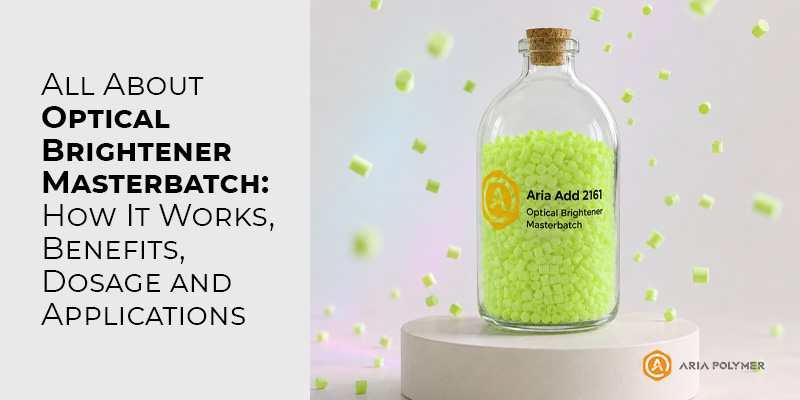
Optical brightener masterbatch (also called OB masterbatch or fluorescent whitening masterbatch) is an additive concentrate. It contains a high loading of an optical brightening agent (OBA), also known as a fluorescent whitening agent, dispersed in a carrier resin.
The concentrate comes as free-flowing pellets. Processors blend a small amount with natural resin at the machine, so the brightener spreads evenly through the final product without handling fine powders.
In plastics, the active ingredients are usually benzoxazole-type brighteners chosen for their heat stability, such as the grades sold as OB and OB-1. Exact chemistry and loading differ by supplier, so check the technical data sheet.
How Does an Optical Brightener Work?
An optical brightener works through fluorescence, not by adding pigment:
- The brightener absorbs invisible ultraviolet (UV) light from daylight or indoor lighting.
- It re-emits that energy as visible blue to blue-violet light.
- The added blue light cancels the natural yellow tint of the polymer.
- The eye sees the part as whiter and brighter than it really is.
Because it adds light rather than absorbing it, an optical brightener can make a product look “whiter than white”. It can also hide yellowing caused by heat during processing and by light during storage.
Note that an optical brightener is not a UV stabilizer. It makes plastic look whiter, but it does not protect the polymer from UV degradation outdoors. For outdoor products, combine it with a UV stabilizer masterbatch.
Key Benefits of Optical Brightener Masterbatch
- Higher whiteness and brightness: white and pastel parts look cleaner and more attractive on the shelf.
- Corrects yellowing: masks the yellow tint of base resins, processing heat and recycled content.
- Better colour brilliance: coloured articles also gain a cleaner, more vivid initial shade.
- Lower TiO₂ demand: a brightener can reduce the amount of titanium dioxide needed for a target whiteness, which can lower cost and help keep films clear with low haze.
- Improved gloss and print contrast: surfaces look glossier and printed graphics appear sharper.
- Effective at low dosage: a small let-down ratio gives a visible effect (up to 2% of the final mix).
- Clean, dust-free handling: pellets dose easily and disperse evenly, with no fish eyes or streaks when well formulated.
- Compatible with other additives: can be used alongside slip, antiblock, UV, filler and colour masterbatches.
- No loss of properties: at recommended levels it should not affect strength, flexibility or processing stability.
Carrier Resins, Compatible Polymers and Dosage
Optical brightener masterbatch is most often supplied in a PE or PP carrier. Grades are also available for PS, ABS, PET and EVA, and some suppliers will match the carrier to your base polymer. It works in virgin resins and in recycled blends.
The brightener must survive melt processing. Good grades stay stable at the processing temperatures of polyolefins and engineering plastics, so they do not yellow or lose effect in the barrel.
Dosage depends on three things: the brightener concentration in the masterbatch, the base resin, and the whiteness you need. Published ranges differ between suppliers, from around 0.1–0.5% for concentrated grades up to about 2% for lower-loaded grades. Always follow the supplier’s technical data sheet and run a short trial.
Do not overdose. Too much brightener does not make the part whiter. It can give a visible blue or violet cast and may increase the risk of blooming.
Applications of Optical Brightener Masterbatch
OB masterbatch suits most plastic processing methods. Common uses include:
| Process | Typical products |
|---|---|
| Blown and cast film | Packaging film, shopping bags, laminates, protective and display films, BOPP |
| Raffia and woven sacks | PP woven bags, big bags, tapes |
| Fibre and monofilament | PP fibres, nonwovens, monofilament |
| Injection moulding | Household goods, toys, closures, consumer products |
| Blow moulding | Bottles, caps, cosmetic containers |
| Sheet, profile and thermoforming | White sheets, profiles, thermoformed trays |
| Recycling | Upgrading the colour of recycled PE, PP and blends |
It is especially useful in recycled plastics, where yellow or grey tints are common. A small dose of brightener can bring recycled content closer to the look of virgin material.
For food-contact packaging, ask the supplier for a food-contact compliance statement for the specific grade.
ARIA POLYMER OB Masterbatch
ARIA POLYMER manufactures a wide range of additive masterbatches, including optical brightener masterbatch, to meet diverse polymer processing requirements. For product grades, technical datasheets, samples, pricing, and technical consultation, please contact us.
Stay informed about the latest Aria Polymer’s products by following our LinkedIn page.