



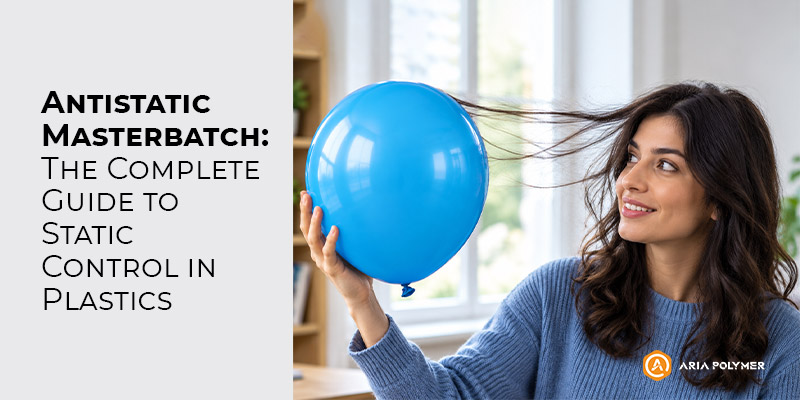
Antistatic masterbatch is a concentrated additive that stops plastic products from holding on to electrostatic charge. Added at a few percent during extrusion, blow molding or injection molding, it helps film, packaging, fibers and molded parts release static instead of attracting dust, clinging together or giving off a spark.
Plastics are excellent electrical insulators, and that is exactly why they charge up so easily. Left uncontrolled, static leads to dirty surfaces, jammed packaging lines, damaged electronic components and, in the worst case, ignition of flammable vapors or dust.
This guide explains what antistatic masterbatch is, how it works, which types are available, where it is used, and how to choose, dose and process the right grade for your product.
What Is Antistatic Masterbatch?
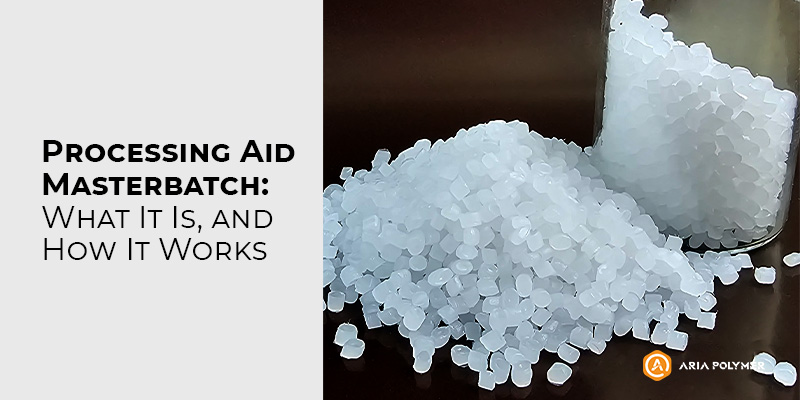
Antistatic masterbatch is a concentrate of antistatic agents dispersed in a carrier resin and supplied as pellets. You blend it into the base polymer, most often polyethylene (PE) or polypropylene (PP), on the extruder or molding machine at a set dosage.
Because the agent is mixed through the whole polymer instead of being sprayed or painted on, the protection is built into the product and does not simply wipe off with handling or abrasion.
Using a masterbatch rather than loose powders or liquids has clear practical advantages:
- Uniform dispersion: the agent arrives pre-dispersed in a polymer carrier, so it mixes evenly into the melt.
- Clean, accurate dosing: pellets feed through standard hoppers and dosing units without dust or sticky residues.
- No extra process step: it goes in during the normal extrusion or molding cycle on existing equipment.
- Repeatable results: batch-to-batch consistency is far easier to hold than with hand-mixed additives.
Why Plastics Build Up Static, and Why It Matters
Static electricity is an imbalance of electrical charge on a surface. Plastics are inherently good insulators, with volume resistivity typically between 10¹² and 10¹⁶ ohm-cm, so once a charge forms it has nowhere to go.
Charge forms whenever two materials touch and separate, or rub against each other. In a plastics plant that happens constantly: pellets sliding through conveying lines, melt moving across metal surfaces in extruders and molds, film being unwound and slit, parts being cut, assembled and packed. After a discharge the charge tends to build up again, so a one-time fix is not enough.
The consequences show up across the value chain:
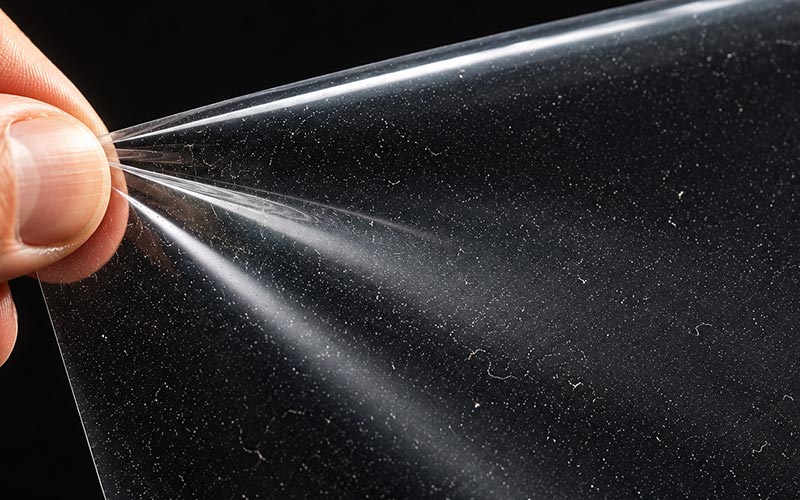
- Dust and dirt pickup: charged surfaces attract airborne particles, which spoils appearance and calls for extra cleaning. This is critical in cleanrooms and medical packaging.
- Sticking and clinging: films and sheets cling to each other and to equipment, slowing unwinding, bag opening, stacking and packing.
- ESD damage: an electrostatic discharge can destroy or weaken sensitive electronic components.
- Fire and explosion risk: a strong enough spark can ignite flammable vapors, solvents or powders.
- Operator shocks: unpleasant for workers and a nuisance on any production line.
How Antistatic Masterbatch Works
An antistatic additive does not stop charge from forming. It lowers the surface resistivity of the plastic so that charge can spread out and leak away before it builds to a harmful level.
The most common migratory (hygroscopic) grades work in five steps:
- The antistatic agent is dispersed in the polymer melt during processing.
- As the product cools, the agent, which is only partly compatible with the polymer, gradually migrates toward the surface.
- Its hydrophilic (water-attracting) groups pull moisture from the surrounding air and form an ultra-thin conductive film.
- Static charge travels through this film and dissipates instead of accumulating.
- As surface agent is lost to handling or evaporation, more moves out from inside the product, keeping the layer in place until the reserve is used up.
Humidity matters. Because these agents rely on moisture from the air, they work best at moderate humidity (around 40–60% relative humidity is often cited) and less well in very dry air. Well-designed formulations hold up across a much wider humidity range, so it is worth testing candidate grades at the driest conditions your product will actually see.
Other antistatic technologies skip the moisture step altogether. Permanent systems create a conductive path inside the plastic itself, either through polymers with built-in charge-dissipating chemistry or through conductive fillers such as carbon black. They are covered in the next section.
Types of Antistatic Masterbatch
Grades fall into three main families. The right one depends on how long protection must last, how dry the environment is and how low the resistivity needs to be.
| Type | How it works | Humidity-dependent | Durability | Typical loading | Typical uses |
|---|---|---|---|---|---|
| Migratory (hygroscopic) | Agent migrates to the surface and attracts moisture | Yes | Temporary to medium-term; fades as the agent is depleted | About 1–5% of the final compound | PE and PP film, bags, packaging, general moldings |
| Permanent (polymeric) | Polar polymer chains, such as polyethers, dissipate charge inside the plastic | Low | Lasts the life of the product | About 5–15% of the final compound | Long-life housings and parts, ESD-sensitive products |
| Conductive filler | Carbon black or carbon fiber forms a conductive network through the polymer | No | Permanent | Filler content roughly 5–20% by weight, depending on filler type | ESD trays, hazardous-area parts, dark-colored products |
Loadings are indicative. Always confirm the dosage on the supplier’s data sheet for your polymer and wall thickness.
Heat stability is a separate selection point. Standard hygroscopic agents can degrade or evaporate above roughly 240–260 °C, so polymers such as polyamides and some polyesters call for heat-stable grades rated for processing up to about 280–300 °C.
Surface resistivity at a glance
Surface resistivity, measured in ohms per square (Ω/sq), is the standard way to classify how well a material controls static.
| Class | Surface resistivity (Ω/sq) | What it means |
|---|---|---|
| Insulating | Above 10¹² | Holds charge, so static builds up |
| Antistatic (dissipative) | 10⁹ to 10¹² | Charge bleeds away; the usual target for film, packaging and general parts |
| Conductive | Below 10⁹ | Charge flows freely; used where fast, controlled discharge is required |
Boundaries vary between standards, so check the one your customer specifies.
Key Benefits of Antistatic Masterbatch
- Cleaner, better-looking products. Less static means less dust pickup, fewer surface defects and less cleaning before shipping.
- Smoother production and converting. Film and sheet separate and unwind cleanly, bags open easily, and parts do not cling to each other or to guides and hoppers.
- Protection for electronics. Controlled surface resistivity helps prevent electrostatic discharge damage during storage, transport and assembly.
- Added safety. Lower charge accumulation reduces the chance of sparks near flammable materials.
- Low cost and easy to use. A few percent in the formulation, dosed on existing equipment, can remove problems that would otherwise cost scrap, rework and customer complaints.

Applications of Antistatic Masterbatch
- Plastic film and packaging. PE and PP films, bags and sheets stay cleaner and run smoothly on filling and packing lines. For food packaging, choose grades that comply with FDA and EU food-contact rules.
- Electronics and ESD packaging. Trays, component packaging and device housings use antistatic or dissipative grades, commonly targeting 10⁹–10¹¹ Ω/sq. Standards such as ANSI/ESD S20.20 and IEC 61340-5-1 set the requirements.
- Interior and exterior plastic parts resist dust attraction, so surfaces stay cleaner before and after assembly.
- Woven fabrics, fibers and agriculture. PP raffia bags, FIBC (bulk) bags, shade nets and greenhouse twines are static-prone and benefit from masterbatch added to the tape or yarn.
- Healthcare and cleanrooms. Medical device parts and packaging need low particle attraction, with typical targets around 10¹⁰–10¹¹ Ω/sq.
- Logistics, storage and hazardous areas. Containers, liners and equipment used around flammable vapors or powders need tighter control, often with permanent grades and lower resistivity. Requirements come from standards such as NFPA 77 and the ATEX directives.
Dosage, Processing and Compatibility
Getting the most from antistatic masterbatch comes down to a few practical points.
- Dosage. Migratory grades are commonly used at about 1–5% of the final compound, and permanent systems need more. The right level depends on the polymer, film thickness or wall section, target resistivity and service humidity. Start from the supplier’s recommended range and confirm with trials.
- Dispersion. Poor mixing leaves patches with little protection. Use accurate dosing equipment and a screw design that disperses well without excessive shear.
- Temperature. Keep the melt within the grade’s temperature limit. Standard hygroscopic grades are typically kept below about 240–260 °C, while heat-stable grades extend this to roughly 280–300 °C.
- Conditioning time. Migratory additives need time to reach the surface, so measure performance after the product has conditioned, not straight off the line.
- Other additives. Check compatibility with pigments, UV stabilizers, flame retardants and processing aids. Acidic additives can react with basic antistatic agents, and some flame retardants compete for the surface.
- Polycarbonate. Some additives can corrode PC, so use grades confirmed as non-corrosive for it.
Verify results with surface resistivity measurements (for example ASTM D257), charge decay tests where dynamic performance matters, and tests at the low end of the humidity range your product will meet.
How to Choose the Right Antistatic Masterbatch
Work through these questions with your supplier before running trials:
- What is the base polymer? Match the masterbatch carrier to PE, PP or your engineering resin so it blends evenly.
- What protection level is required? Define a target surface resistivity or charge-decay time, and the standard it must meet.
- How long must it last? Short-term handling protection points to migratory grades; protection for the life of the product points to permanent systems.
- How dry is the environment? Very dry service conditions favor permanent or humidity-independent solutions, or migratory grades proven at low humidity.
- What are the processing temperatures? Choose heat-stable grades for high-temperature polymers.
- Which regulations apply? Food contact (FDA, EU), REACH or RoHS for electronics, and recyclability goals can all narrow the options.
- Do appearance and color matter? Carbon-black systems are always dark; migratory grades are the usual choice when clarity or light colors are needed.
- What technical support is available? Look for a supplier that provides data sheets, test reports, samples and a certified quality system such as ISO 9001.
When in doubt, run side-by-side trials of two or three grades and measure them under your own production and storage conditions.
ARIA POLYMER antistatic masterbatch
ARIA POLYMER manufactures high-quality antistatic masterbatches for the plastics industry. Our technical team is ready to help you select the most suitable antistatic masterbatch for your specific application. Contact us to find the right solution for your needs.
ARIA POLYMER
Aria Polymer is a manufacturer of various polymer additives, including additive masterbatches, compatibilizers, and tie layer adhesives.
Stay informed about the latest Aria Polymer’s products by following our LinkedIn page.