



If you work in plastics compounding or plastic recycling, you have almost certainly seen the words compatibilizer and coupling agent used as if they were interchangeable. Some suppliers list them as synonyms. Others sell them as two separate product families. Both camps have a point, and choosing the wrong additive can mean weak parts, unstable blends and wasted trials.
This guide explains what each additive does, where the two terms overlap, the one practical distinction that actually matters, and how to select the right product for your formulation.
Quick Answer: Compatibilizer vs Coupling Agent
A compatibilizer improves adhesion between two different polymers, for example polypropylene (PP) and polyamide (PA). A coupling agent improves the bond between a polymer and a filler or fibre, for example polypropylene and glass fibre or wood flour.
The chemistry is often the same: maleic anhydride grafted polyolefins are used for both jobs. What changes is the interface the additive works on.
What Is a Compatibilizer?
Most polymer pairs do not mix at the molecular level. When they are melt-blended, they separate into phases, typically droplets of one polymer dispersed in a matrix of the other. The boundary between these phases is weak and carries high interfacial tension. The result is a coarse, unstable morphology that shows up as brittleness, poor tensile and impact performance, delamination and, in film extrusion, streaks and gels.
A polymer compatibilizer is an additive that sits at this boundary and strengthens it. It lowers interfacial tension, helps the dispersed phase break into finer and more uniform domains, resists re-coalescence during processing, and lets stress pass from one phase to the other instead of cracking along the interface. That is why compatibilized blends usually deliver better strength, elongation and impact resistance, and why they can be tuned for demanding applications in automotive, packaging and electronics.
Two Ways Compatibilizers Work
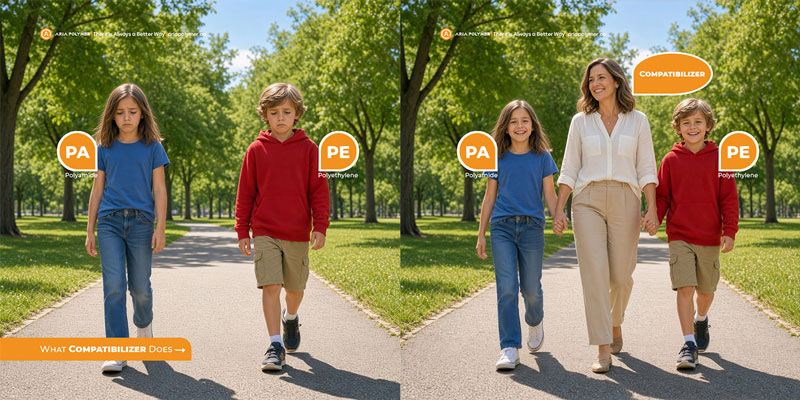
Non-reactive (physical). compatibilization. Block or graft copolymers whose segments are each miscible with one of the two phases. They migrate to the interface and anchor into both sides, much like a stitch. A styrenic block copolymer placed between polystyrene and a polyolefin is a classic example.
Reactive compatibilization. Polymers carrying functional groups, most commonly maleic anhydride (MAH) or glycidyl methacrylate (GMA), react during extrusion with groups on the second polymer, such as the amine end groups of polyamide. The reaction builds a graft copolymer in situ, right at the interface. This is the workhorse route for PP/PA, PE/PA and polyolefin/polyester systems.
Where Compatibilizers Are Used
- Engineering polymer compounds and blends (PP/PA, PE/PA, polyolefin/polyester, styrenic alloys)
- Recycling of mixed and multilayer plastics, such as PE or PP films that contain PA or EVOH barrier layers
- Recycled polystyrene (rPS) and recyclates of technical polymers such as TPU, PA and ABS
- Masterbatch and pigment systems where adhesion and dispersion between dissimilar components matter
What Is a Coupling Agent?
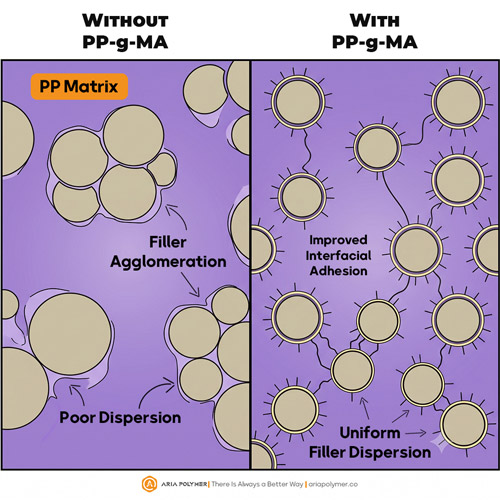
Fillers and fibres pose a different challenge. Glass fibre, minerals and natural fibres such as wood flour are polar and often hydrophilic, while common matrices like polypropylene and polyethylene are non-polar. Without help, the polymer does not wet the filler surface well, particles clump together, and the weak interface cannot transfer load from the matrix to the stiff reinforcement. The composite fails at the boundary long before the filler’s potential is used.
A coupling agent acts as a molecular bridge. One end reacts with, or bonds to, the surface of the filler or fibre. The other end entangles with the polymer matrix or is at least compatible with it. Stress can then flow across the interface, which raises strength and impact performance and usually improves filler dispersion.
Common Types of Coupling Agents
- Silanes, widely used on glass fibre and mineral fillers
- Titanates and zirconates, used with certain inorganic fillers
- Maleic anhydride grafted polyolefins (often called PP-g-MA for polypropylene and PE-g-MA for polyethylene), widely used in polyolefin composites with glass fibre, carbon fibre, wood flour and other natural fibres
Where Coupling Agents Are Used
- Glass fibre and carbon fibre reinforced compounds, including PP glass-fibre grades for automotive parts
- Thermoplastic composite tapes
- Wood plastic composites (WPC) and other natural fibre composites
- Mineral-filled polyolefins
Key Differences at a Glance
| Feature | Compatibilizer | Coupling Agent |
|---|---|---|
| What it joins | Polymer A ↔ Polymer B | Filler or fibre ↔ Polymer matrix |
| Type of interface | Polymer–polymer | Inorganic or natural surface–polymer |
| Problem it solves | Phase separation, coarse morphology, high interfacial tension | transfer |
| Main mechanism | Lowers interfacial tension; forms block or graft copolymer at the interface; stabilizes morphology | Bonds to the filler surface; entangles with the matrix; transfers load |
| Typical chemistries | Styrenic block copolymers; PE-g-MAH, PP-g-MAH, POE-g-MAH, GMA-grafted polymers | Silanes, titanates, zirconates, PP-g-MA, PE-g-MA |
| Typical systems | PP/PA, PE/PA, polyolefin/polyester, multilayer film recyclate, rPS | PP/glass fibre, carbon fibre tapes, wood plastic composites, mineral-filled PP |
| Key benefits | Better impact strength and elongation, stable morphology, fewer gels and streaks | Higher strength and stiffness, better impact, improved dispersion, better moisture resistance |
| The question it answers | “Will these two plastics stay mixed?” | “Will the filler stay bonded to the plastic?” |
Why the Two Terms Overlap
The confusion has a simple root: the same molecule can play both roles. A PP-g-MA grade is a compatibilizer in a PP/PA blend and a coupling agent in a PP/glass fibre compound.
Supplier language reflects this. Some technical pages describe compatibilizers as simply another name for coupling agents. Some data sheets present a single maleic anhydride grafted polyethylene as a grade that compatibilizes PE and PP melt blends and also acts as a chemical coupling agent with inorganic fillers, glass fibre, wood flour and other natural fibres. Other manufacturers separate the two cleanly, listing compatibilizers for the interface between two polymers and coupling agents for the interface between a filler or reinforcing fibre and a polymer.
Neither approach is wrong. The most useful rule in practice is to ask what sits on the other side of the interface:
- Another polymer → you need a compatibilizer
- A filler, fibre or reinforcement → you need a coupling agent
One more nuance: elastomeric grafted grades (for example those based on POE or SEBS) can also act as impact modifiers or toughening agents, so a single additive may handle compatibilization and toughness at the same time, especially in polyamide systems.
Conclusion
Compatibilizers and coupling agents solve the same fundamental problem, a weak interface between two dissimilar materials, but they solve it in different places. Use a compatibilizer when two polymers must work together as a blend or recycled stream. Use a coupling agent when a filler or fibre must bond firmly to the polymer matrix. Because many maleic anhydride grafted products can do both, the right choice comes from your formulation, not the product name.
ARIA POLYMER
ARIA POLYMER manufactures a wide range of high-quality maleic anhydride grafted polymers, including coupling agents and compatibilizers, for various applications in the plastics industry. Explore our Grafted Polymers with Maleic Anhydride page to discover our products and available grades. Need help selecting the right grade for your formulation? Contact Us, our technical team is ready to assist you.
Stay informed about the latest Aria Polymer’s products by following our LinkedIn page.