


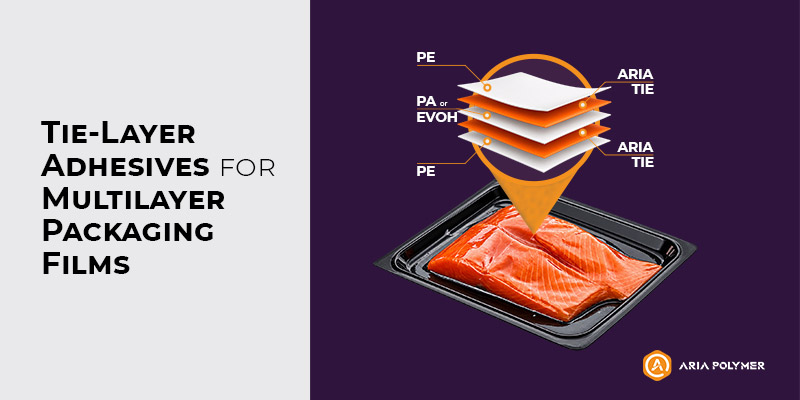
Walk down any supermarket aisle and you will see multilayer films everywhere: meat trays, cheese packs, coffee pouches, vacuum bags and retort pouches. No single plastic delivers every property these packs need. Polyethylene (PE) is tough and heat-sealable, but it lets oxygen through. Ethylene vinyl alcohol (EVOH) offers an excellent oxygen barrier, but it is moisture-sensitive and cannot do the job of a sealant. The answer is to combine several polymers in one film, and the material that makes this possible is the tie-layer adhesive.
A tie-layer adhesive is a thin, co-extruded resin layer that bonds polymers which would otherwise refuse to stick together. Without it, a barrier film would peel apart (delaminate) during production, shipping or storage. This guide explains what tie layer adhesives are, how they work, which types are used in multilayer packaging films, and what to check when choosing one.
What Is a Tie-Layer Adhesive?
A tie-layer adhesive, also called a tie resin, adhesive resin or interlayer adhesive, is a thin layer of functionalized polymer placed between two materials that do not bond on their own. In co-extrusion, the tie resin is melted in its own extruder and delivered between neighbouring layers inside the die. The film is formed and bonded in a single step, with no separate lamination, no solvent to evaporate and no curing time.
This is different from a lamination adhesive. Solvent-based and solventless lamination adhesives are applied to finished films in a later converting step and usually need drying or curing. A tie layer is a solid thermoplastic resin that becomes the adhesive only while the film is being extruded.
Why Multilayer Packaging Films Need Tie Layers
Polyolefins such as LDPE, LLDPE, HDPE and PP are tough, economical and easy to heat-seal, but they are non-polar and offer limited gas barrier. Barrier polymers such as EVOH and polyamide (PA) block oxygen and aromas far more effectively, but they are polar materials with very different chemistry. When polar and non-polar polymers are extruded side by side, they do not fuse into one structure, and the layers separate.
Multilayer films solve the performance problem by giving each layer one job:
- Sealant layer: forms the heat seal and contacts the food.
- Barrier layer: controls the passage of oxygen, aroma and, in some structures, moisture.
- Structural layer: provides stiffness, toughness and puncture resistance.
- Outer layer: carries print and resists abrasion.
- Tie-layers: hold every one of these layers together.
The tie-layer is usually the thinnest layer in the film, yet it decides whether the other layers can do their jobs. A delaminated film loses its barrier continuity, seal strength and appearance, and gaps between layers can let moisture and oxygen reach the food. That shortens shelf life and increases the risk of product loss and customer complaints.
How Tie Layer Adhesives Work
The most common tie resins are polyolefins, usually PE or PP, chemically modified with maleic anhydride (MA) through reactive extrusion. This gives each molecule two complementary characteristics:
- A polyolefin backbone that is compatible with PE or PP layers, so it blends into and entangles with that side of the interface.
- Grafted polar groups (acid or anhydride) that can react with, or form strong polar interactions with, the hydroxyl groups of EVOH and the amine end groups of polyamide, creating strong interfacial adhesion.
Because tie-resins cost more than standard PE, converters often dry blend them with unmodified PE. This lowers material cost while keeping adhesion at the level the structure requires. The right dilution depends on the grade, the layers involved and the adhesion target, so it should always be confirmed by peel testing on your own line.
Common Types of Tie-Layer Resins
- MA-grafted LLDPE: a widely used choice for bonding PE to EVOH or PA in blown and cast barrier films, valued for consistent adhesion and processing.
- MA-grafted LDPE: typically has a lower melt index, which supports bubble stability in blown film extrusion.
- MA-grafted HDPE: suited to stiffer structures and applications that need higher heat resistance than standard LDPE or LLDPE.
- MA-grafted PP: designed for polypropylene-based structures, including heat-resistant packs such as hot-fill, pasteurized and retort applications.
- EVA and other copolymer-based tie resins: used where lower processing temperatures or extra flexibility are needed.
The best grade always depends on the specific barrier resin, the neighbouring layers, the extrusion process and the sterilization or storage conditions the pack will face.
Typical Multilayer Film Structures
Tie-layers appear on both sides of the barrier layer in most barrier films. Common examples include:
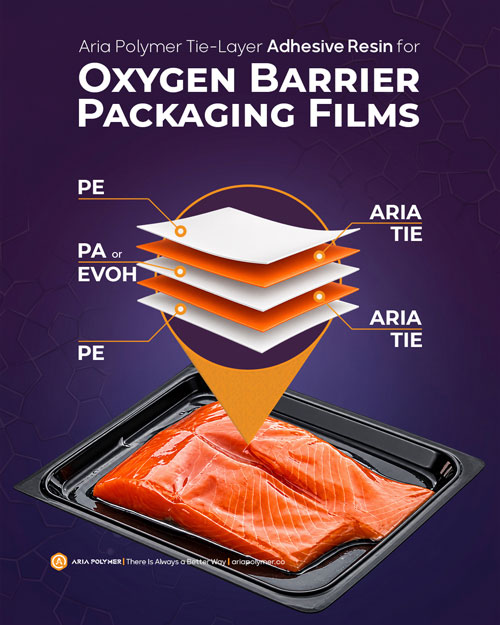
- PE / Tie / EVOH / Tie / PE
- PE / Tie / PA / Tie / PE
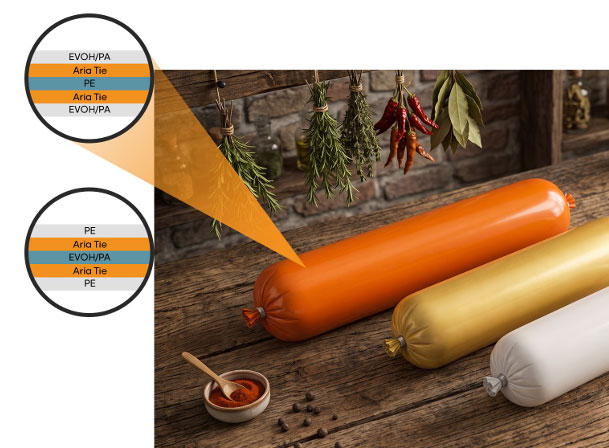
- EVOH or PA / Tie / PE / Tie / EVOH or PA
- PP / Tie / EVOH / Tie / PP
Blown film lines can produce films with ten or more layers. Placing EVOH between tie layers and polyolefin skins also protects it from humidity, which would otherwise reduce its barrier performance.
Blown vs Cast Co-Extrusion: What It Means for Tie-Layer Selection
Most multilayer packaging films are produced by one of two co-extrusion routes, and each places different demands on the tie resin.
Blown film co-extrusion. Polymer melts are extruded upward through an annular die to form a thin-walled tube, which is inflated like a balloon and cooled by a high-speed air ring. The layers remain separate until they reach the die tips, so rheology matching between layers is less critical than in cast extrusion. This makes material selection more flexible. PE is usually the best fit for this process, and typical blown film thickness falls between about 30 and 200 µm. Because bubble stability matters, tie resins with good melt strength are valuable here.
Cast film co-extrusion. Polymer streams are combined in a feedblock and spread through a flat, coat-hanger style die. Laminar flow is essential, so the viscosity of the tie resin must be closely matched to the neighbouring layers to keep layer thickness even. Cast extrusion is often preferred for PP, PET and PA. For this process, melt flow index (MFI) matching is the first thing to check.
How to Choose the Right Tie Layer Adhesive
Use these criteria when evaluating tie resins for a multilayer film:
- Compatibility with adjacent layers. Match the base resin (PE or PP) to the polyolefin layers and the functional chemistry to the barrier layer (EVOH, PA or another polar polymer).
- Melt flow and rheology. Choose an MFI that suits your process and is close enough to the neighbouring layers to avoid interfacial instability or uneven layer thickness.
- Adhesion level. Check peel strength against your requirement, remembering that grafting level, dilution ratio and tie layer thickness all influence the result.
- Processing window. EVOH and PA are heat-sensitive. The tie resin should process comfortably within the temperature range that these barrier polymers allow, without degradation or gel formation.
- Adhesion retention. The bond must survive the real life of the pack, including temperature and humidity changes, pasteurization or retort, and long storage.
- Food contact compliance and cleanliness. Look for suitable certification, low odor and low gel content.
- Storage stability. Tie resins should keep stable viscosity and bonding performance over their shelf life. MAH groups can react with moisture over time, so store the resin in sealed, moisture-proof packaging and follow the recommended storage conditions.
Food Safety and Regulatory Considerations
In food packaging, the adhesive layer must not compromise the safety of the product. Tie resins should be designed for food contact applications and comply with the regulations that apply in your market, such as Regulation (EU) No 10/2011 for plastics in contact with food and the relevant sections of 21 CFR in the United States. Compliance is determined for each specific grade and intended use, so always request current declarations of compliance and migration data from your supplier. Where possible, design the structure so that the tie-layer is not the layer in direct contact with the food.
ARIA POLYMER Adhesives
ARIA POLYMER manufactures a wide range of high-quality tie-layer adhesive resins for multilayer packaging films. Explore our grades on our “Film & Packaging Adhesive” page. Also our technical team is ready to help you select the most suitable adhesive grade for your specific layer structure and application. For expert guidance, visit our Contact Us page to get in touch with our team.
You can also download our catalog, “Tie-Layer Adhesive Resin Solutions for Packaging” to explore our products and solutions.
Stay informed about the latest Aria Polymer’s products by following our LinkedIn page.