



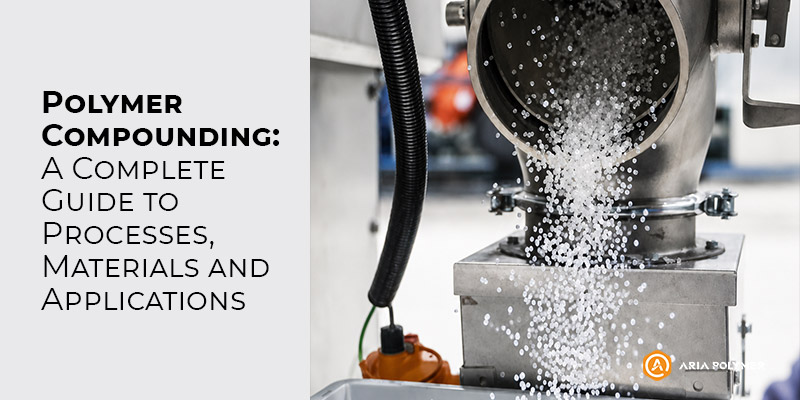
Polymer compounding is how a plain plastic resin becomes a material that is genuinely fit for a job. Raw polymers are useful, but on their own they rarely deliver the exact mix of strength, heat resistance, flame performance, color and cost that a real product demands. Compounding closes that gap by melt-blending a base polymer with additives, fillers, reinforcements and sometimes other polymers. In this guide you will learn what polymer compounding is, what goes into a compound, how the process works step by step, which equipment does the heavy lifting, and where compounded plastics end up.
What Is Polymer Compounding?
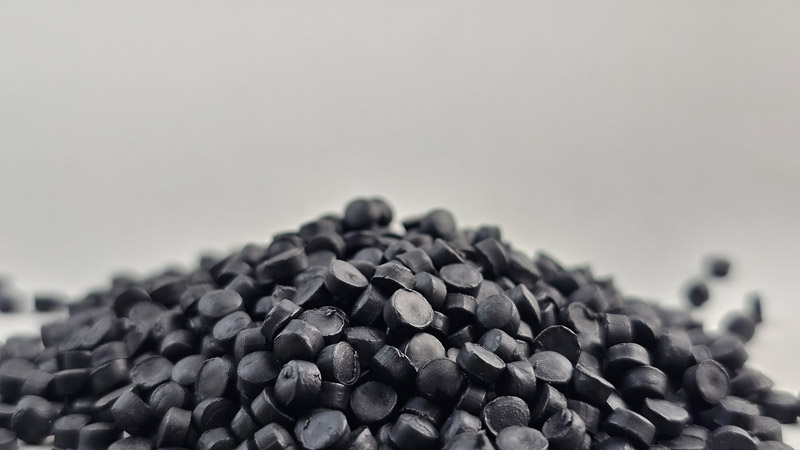
Polymer compounding, also called plastics compounding, is the process of melting a base polymer and blending it with other ingredients so that they are evenly distributed throughout the material. Those ingredients can be additives, mineral fillers, glass or carbon fibers, pigments, or a second polymer. The end product is called a compound, and it is normally supplied as small pellets that downstream processors turn into parts by injection molding, extrusion or blow molding.
The goal is to change, and usually improve, the physical, thermal, electrical or aesthetic behavior of the polymer. In that sense compounding is the bridge between a commodity resin and an application-ready engineering material.
Why Raw Resins Are Rarely Enough
No single polymer is best at everything. A resin that is easy to process may be too brittle outdoors; one that is strong may be too expensive or too flammable for an electrical enclosure. Compounding lets manufacturers adjust the balance instead of settling for a compromise. With the right formulation you can:
- Boost stiffness, strength, impact resistance or heat resistance
- Add entirely new functions such as flame retardancy, antistatic behavior or electrical conductivity
- Improve weathering and UV stability for outdoor use
- Control color and surface appearance consistently from batch to batch
- Lower material cost by replacing part of the resin with economical fillers
- Make processing smoother and more repeatable for the molder
What Goes Into a Polymer Compound?
Every formulation is different, but most compounds are built from four groups of ingredients.
Base polymers
The base polymer forms the matrix and sets the starting point for processability and performance. Common choices include polyethylene (PE), polypropylene (PP), PVC, polystyrene (PS), ABS, polyamide (PA), polycarbonate (PC), PBT and thermoplastic polyurethane (TPU). A compound can use one resin or a deliberate blend of two or more, such as a PC/ABS alloy that balances heat resistance, toughness and flow.
Additives
Additives are used in relatively small amounts but have an outsized effect. Plasticizers add flexibility, impact modifiers reduce brittleness, and antioxidants and heat stabilizers protect the polymer during processing and service life. UV stabilizers help parts survive sunlight, flame retardants lower flammability, and lubricants, processing aids and antistatic agents fine-tune how the material runs and behaves. For medical and food-contact uses, antimicrobial additives may also be included.
Fillers and reinforcements
Fillers and reinforcements change stiffness, strength, dimensional stability, heat resistance and cost. Calcium carbonate, talc, wollastonite and barium sulfate are widely used mineral fillers, while glass fiber and carbon fiber are the classic reinforcements. Talc-filled polypropylene, for example, is valued for rigidity and dimensional stability, whereas glass-fiber-reinforced nylon delivers a major jump in mechanical performance.
Colorants and masterbatch
Pigments, dyes and color masterbatches control appearance. Adding color through a masterbatch, a concentrated pellet of pigment or additive in a carrier resin, is a cost-effective and easy-to-handle way to achieve uniform coloration, especially when many colors are needed.
How the Polymer Compounding Process Works
A typical compounding line follows five coordinated stages. Each one influences the consistency and final properties of the compound.
- Formulation design. Engineers choose the base resin, fillers and additives and set their proportions to meet targets for strength, toughness, flame performance, weather resistance, color, electrical behavior, processability and cost.
- Feeding and dosing. Pellets, powders and liquids must enter the machine continuously and in the exact ratio the recipe calls for. Volumetric feeders are simple and economical, while gravimetric (loss-in-weight) feeders measure actual weight and give higher accuracy for demanding formulations.
- Melting and mixing. Heat from the barrel and mechanical energy from the screws melt the polymer, which is then mixed with everything else. This is the heart of the process and relies on two mechanisms: distributive mixing, which spreads the components evenly through the melt, and dispersive mixing, which uses shear to break up agglomerates of fillers and pigments.
- Venting and devolatilization. Moisture, residual solvents and other volatiles are drawn off through atmospheric vents or vacuum ports. Left in the melt, they can cause bubbles, silver streaks, surface defects and weaker parts.
- Extrusion and pelletizing. The homogeneous melt is pushed through a die, cooled with water or air, and cut into pellets. After drying, screening and packaging, the pellets are ready for downstream processing.
Why Twin-Screw Extruders Dominate Compounding
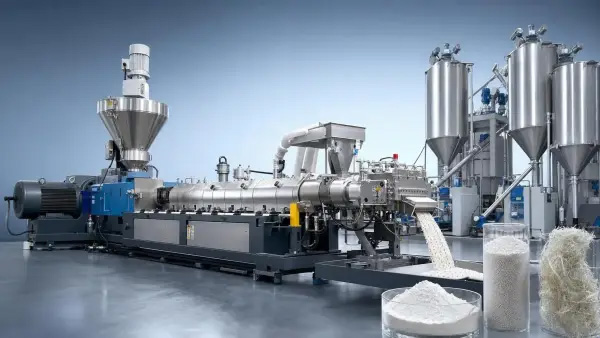
For most continuous industrial work, the co-rotating intermeshing twin-screw extruder is the machine of choice. Its two screws turn in the same direction and intermesh, which creates strong kneading and shear while conveying the material forward. Because the screws wipe each other clean, there is little material stagnation, and the process runs steadily.
The real advantage is modularity. Screw shafts are assembled from conveying elements, kneading blocks and other functional pieces, and barrel sections can be fitted with main feeders, side feeders, liquid injection ports and vents. Changing the layout alters mixing intensity, feeding positions and the length-to-diameter ratio, so a single platform can handle very different formulations. Mineral fillers and glass fibers can be side-fed downstream of the melting zone, liquid additives can be metered in, and volatiles can be pulled out under vacuum. A twin-screw extruder can even act as a continuous reactor for processes such as grafting and chain extension.
Other technologies, including co-kneaders and internal batch mixers, also have their place, and laboratory micro-compounders let developers test small batches of a new formulation before scaling up.
Polymer Compounding vs. Dry Blending
The two terms are often confused, but they describe different things. Dry blending physically tumbles resin pellets or powders with additives while the polymer stays solid. Nothing is dispersed inside a molten matrix, so the mix is only as good as the next processing step makes it.
Compounding goes further. The polymer is melted and subjected to intensive mixing so that additives, fillers and reinforcements are dispersed and homogenized. Dry blending is about combining raw materials; compounding is about achieving controlled dispersion and building the properties the application needs.
Common Types of Polymer Compounds
| Compound type | Main purpose | Typical ingredients | Example uses |
|---|---|---|---|
| Filled | Raise stiffness and dimensional stability, reduce cost | Talc, calcium carbonate | Talc-filled PP for appliances and car interiors; calcium-carbonate-filled PE for pipes and cable jackets |
| Reinforced | Increase strength, stiffness and heat resistance | Glass fiber, carbon fiber | Glass-fiber-reinforced PA for mechanical parts; glass-fiber-reinforced PBT for connectors |
| Flame-retardant | Reduce flammability and meet fire standards such as UL 94 V-0, V-1 or V-2 | Flame retardants and synergists | Electrical housings, wire and cable compounds |
| Conductive and antistatic | Modify electrical behavior | Carbon black, carbon nanotubes, antistatic agents | Electronic packaging, handling trays, shielding components |
| Color and appearance | Control color and visual effects | Pigments, dyes, masterbatch | Appliance housings, automotive trim, consumer electronics |
| Rubber and elastomer | Add impact strength and flexibility | Elastomers such as EPDM blended with PP, PS or nylon | Seals, gaskets, hoses, diaphragms |
Where Compounded Polymers Are Used
Automotive. Reinforced and impact-modified compounds replace metal in bumpers, body panels, engine covers and interior parts, cutting weight while keeping durability and safety. Rubber compounds serve tires, seals and hoses.
Electrical and electronics. Flame-retardant, insulating, conductive and antistatic grades are used in wire and cable insulation, connectors, housings and encapsulation of sensitive components.
Aerospace and transport. Carbon-fiber-reinforced polymers offer excellent strength-to-weight ratios, and fire-retardant and insulating compounds support passenger safety and comfort.
Healthcare. Compounds can be tailored for chemical resistance, sterilization requirements and biocompatibility in tubing, devices, packaging and prosthetics.
Construction. PVC and PE compounds are used for pipes and fittings because of their corrosion resistance and longevity, while other formulations deliver weather resistance, insulation and flame retardancy.
Consumer goods and packaging. From durable household items and sports equipment to barrier films that extend shelf life, compounding shapes the everyday products people use.
What Determines Compound Quality?
Several factors interact, and balancing them is the real craft of compounding.
- Screw configuration. The arrangement of conveying, kneading and mixing elements sets shear and mixing intensity.
- Screw speed and throughput. Together they affect shear, energy input, fill level and residence time.
- Temperature and residence time. Too little heat or time leaves the melt poorly mixed; too much can degrade the polymer or its additives.
- Feeding accuracy and location. Consistency depends on precise dosing, and the point of addition matters. Glass fibers, for example, are usually side-fed after the polymer has melted to limit fiber breakage.
- Poorly compatible polymer blends often need a compatibilizer to improve adhesion between phases.
- Moisture control. Hygroscopic resins such as PA, PET, PC and TPU need proper drying to avoid hydrolysis, bubbles and lost performance.
More mixing is not always better. In fiber-reinforced compounds, enough mixing spreads the fibers evenly, but excessive shear shortens them and weakens the material.
Coupling agents & Compatibilizers
In polymer compounding, the use of coupling agents and compatibilizers is essential to achieving high-quality compounds. These additives improve the compatibility between polymers and fillers, ensuring uniform dispersion and distribution while minimizing agglomeration and enhancing the overall properties of the final product.
ARIA POLYMER manufactures a wide range of coupling agents and compatibilizers to meet diverse polymer compounding needs. Explore our product range on this page.
Stay informed about the latest Aria Polymer’s products by following our LinkedIn page.