


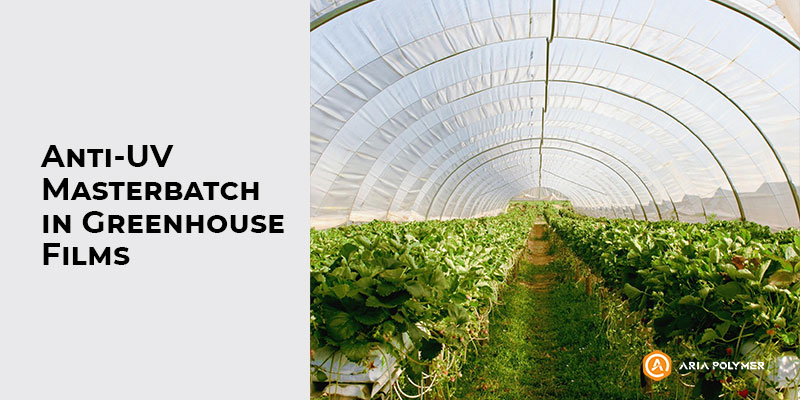
Accelerating global population growth and unprecedented climate change have plunged traditional agriculture into severe crises, including water scarcity, soil erosion, and extreme weather volatility. In response, the emergence of Plasticulture—the application of polymeric materials in agriculture—represents a paradigm shift in global food security. At the forefront of this technology are greenhouses: controlled artificial ecosystems designed to regulate climate conditions and maximize crop yields year-round.
The beating heart of these modern ecosystems is the thin polymeric coating commonly known as greenhouse film or sheeting, which forms the critical barrier between harsh external environments and the plant canopy. Today, the vast majority of these greenhouse films are engineered from single-layer and multi-layer polyethylene resins.
Greenhouse Films: Degradation Mechanics & Stabilization
While polymer films are the unrivaled choice due to their flexibility, superior optical transparency, and cost-effectiveness, their primary vulnerability lies in the very environment they operate in: continuous exposure to solar ultraviolet (UV) radiation in the 290–400 nm wavelength range.
The absorption of high-energy UV photons—whose energy exceeds the bond strength of covalent C−C and C−H structures—initiates free radical reactions. As the polymer undergoes initiation, propagation, and chain scission, its molecular weight drops, yellowing occurs, and micro-cracking develops. This leads to a catastrophic loss in mechanical performance, particularly elongation at break. Consequently, films engineered to last for years become brittle, fragile, and structural failures within months.
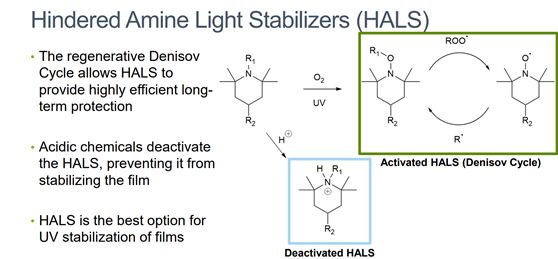
To neutralize this degradation and achieve the industry-standard service life of 3 to 5 years, incorporating specialized masterbatch technology with uniformly dispersed light stabilizers is imperative. These masterbatches typically combine UV Absorbers with Hindered Amine Light Stabilizers (HALS). Utilizing the catalytic, self-regenerating Denisov Cycle, HALS compounds act as radical scavengers, effectively halting photolytic degradation.
Agricultural Chemical Interference & Next-Generation NOR-HALS Technology
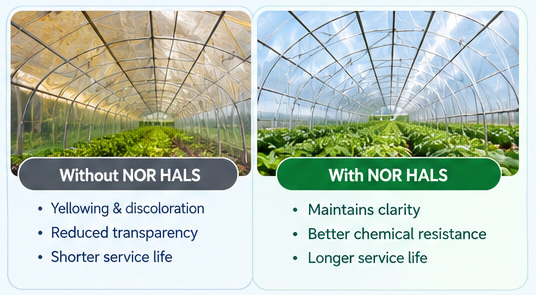
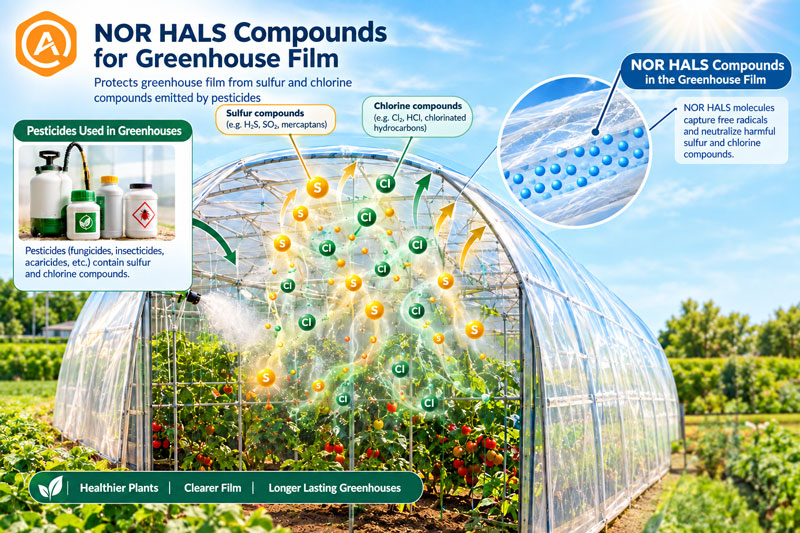
However, the challenge extends far beyond solar radiation. Agricultural plastics operate in an aggressive environment, enduring not only high UV stress and thermal loads, but also direct exposure to agrochemicals—specifically chlorine used for disinfection and sulfur-based pesticides and fertilizers applied for crop protection and soil management.
Sulfur and chlorine are the most prevalent active compounds in commercial agrochemicals. In the greenhouse environment—effectively a complex chemical reactor—these substances react with and deactivate standard UV stabilizers, triggering premature polymer degradation and severely compromising film longevity. Chemically, agrochemicals generate acidic byproducts that protonate and neutralize conventional basic HALS additives, neutralizing their stabilization capacity. Driven by this chemical antagonism and compounded by physical abrasion from soil particulates, the polymer industry has advanced toward next-generation NOR-HALS (non-basic amine) UV stabilizers engineered specifically to resist agrochemical poisoning and extend operational lifespan.
Ultimately, the objective of developing advanced anti-UV masterbatches extends far beyond merely extending the mechanical lifespan of the plastic film. A durable greenhouse film that retains its optical clarity and PAR (Photosynthetically Active Radiation) light transmission over time directly dictates the quality and intensity of light reaching the crop canopy.
Optimal light stabilization prevents foliage scorch from direct sunlight, optimizes diurnal thermal regulation, and preserves plant health to maximize crop yields. Consequently, the engineering and optimization of anti-UV masterbatches for greenhouse applications represent the critical nexus of polymer science, processing technology, and agricultural biology in modern controlled-environment agriculture.
Agrochemical Impact & The NOR-HALS Solution
Inside greenhouse environments, growers routinely apply insecticides and fungicides containing elevated levels of sulfur and halogens. In the presence of moisture and solar radiation, sulfur oxidizes into corrosive acids, such as sulfuric acid.
UV Stabilizer Deactivation Mechanism
Conventional Hindered Amine Light Stabilizers (HALS) possessing N-H or N-CH3 amine chemistry are intrinsically basic. When exposed to agrochemical-derived acids, the nitrogen atom undergoes rapid protonation, forming quaternary ammonium salts:

Once converted into ammonium salts, these additives lose their capability to oxidize and re-enter the self-regenerating Denisov Cycle. Consequently, the polymer matrix is left unprotected, leading to rapid, uninhibited degradation and structural failure
Industrial & Engineering Solution: The NOR-HALS Anti-UV masterbatch
The presence of the electron-withdrawing oxygen atom adjacent to nitrogen significantly reduces the electron density on the nitrogen center, virtually neutralizing the molecule’s basicity.
By eliminating basicity, acid-base neutralizations between the HALS and acidic agrochemical residues are minimized. Consequently, even in harsh, sulfur-rich, and highly acidic greenhouse environments, NOR-HALS molecules remain unprotonated—maintaining their catalytic radical-scavenging cycle at peak efficiency.
Evaluating Performance & Lifespan of Greenhouse Films: Mechanical Testing
In the commercial polymer industry, the ultimate failure criterion defining the end-of-life for a greenhouse film is the macroscopic degradation of its mechanical properties—specifically, when Elongation at Break degrades to below 50% of its initial value.
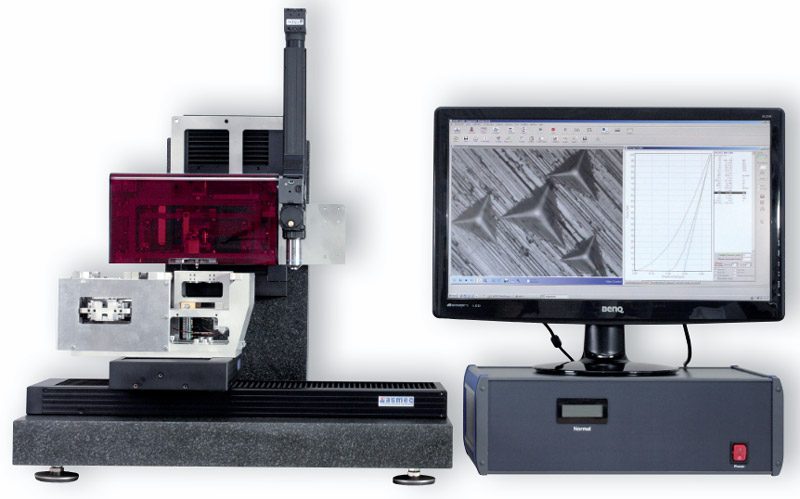
To assess surface degradation at a micro-scale level, a Universal Nano mechanical Tester (UNAT) equipped with a Berkovich indenter is utilized. This instrument measures localized shifts in Young’s Modulus and elasticity across the micron scale, directly quantifying UV-induced surface crystallization and embrittlement.
ARIA POLYMER Anti-uv Masterbatch
ARIA POLYMER manufactures a wide range of masterbatches, including anti-uv masterbatch. This product helps extend the service life of plastic components by preventing yellowing and color changes caused by prolonged outdoor exposure.
ARIA POLYMER’s UV masterbatch, also known as a UV absorber or UV stabilizer, is specifically designed to enhance durability and prevent discoloration in plastic products, particularly in the production of greenhouse films.


Stay informed about the latest Aria Polymer’s products by following our LinkedIn page.