



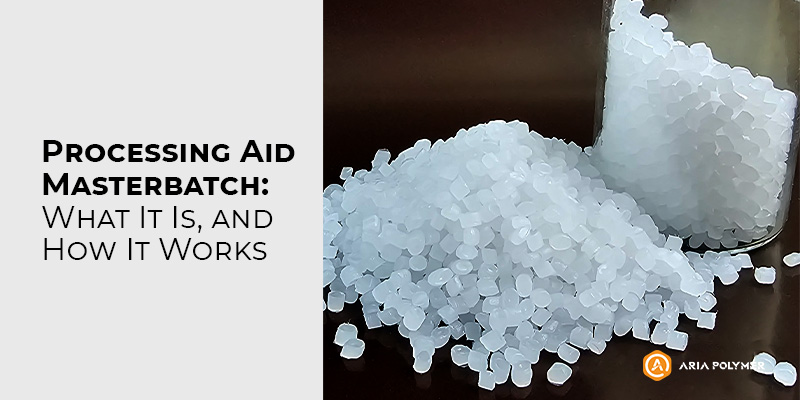
Processing aid masterbatch (also known as polymer processing aid masterbatch or PPA masterbatch) is a concentrated additive that helps polymer melts flow smoothly through extruders and dies. It reduces melt fracture, die build-up and motor load, so production lines run cleaner, longer and with less energy.
If you extrude film, pipe, cable, fibre or filled compounds, you have probably met the problems it solves: sharkskin surfaces, die lines, gels, rising head pressure and frequent stops to clean the die. A small dose of the right processing aid masterbatch often fixes these faster than changing the resin or raising the temperature.
This guide explains what processing aid masterbatch is, how it works, the main types, and where it is used.
What Is Processing Aid Masterbatch?
Processing aid masterbatch is a pelletised concentrate of process-improving additives dispersed in a carrier resin. You dose it into the base polymer at the extruder feed throat, usually at a low percentage, to improve how the melt flows, releases from metal and finishes on the surface.
The pellet form matters. Free-flowing granules are easier to feed accurately than powders or neat additives, and they lower the risk of local over-concentration.
Two components define every grade:
- Carrier resin: usually polyethylene (PE), polypropylene (PP), EVA or polystyrene, chosen to be compatible with the base polymer so the additive disperses evenly.
- Active component: most often a fluoropolymer, but it can also be a silicone-based material, wax, metal soap, lubricant or polymeric flow modifier.
The term is used in two ways. In extrusion, “processing aid masterbatch” usually means a fluoropolymer-based polymer processing aid (PPA). In a wider sense it covers any additive masterbatch that helps manufacturing rather than the part’s service life, such as slip, anti-block or mould-release grades.
How Does Processing Aid Masterbatch Work?
A processing aid masterbatch changes what happens at the boundary between the molten polymer and the metal surfaces of the extruder. Three mechanisms are involved, and one grade may combine several of them.
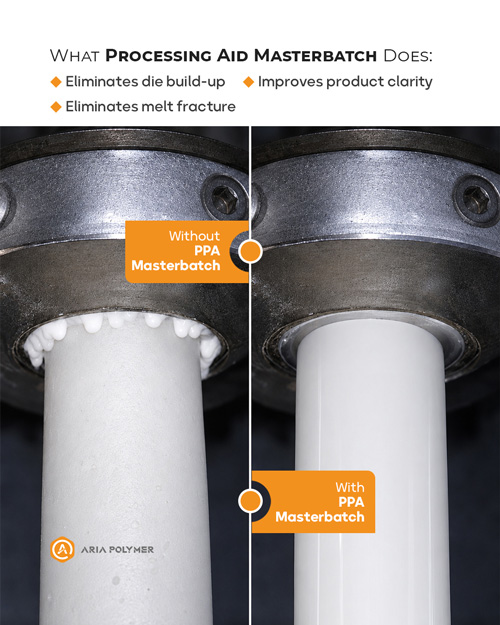
- Interface coating. In fluoropolymer grades, the active separates from the carrier as the pellets melt. It has a strong affinity for metal, so it builds a thin, low-friction layer on the screw, barrel and die. The melt slides over this layer with less resistance, which lowers pressure, torque and motor load.
- Internal lubrication. Lubricant and wax systems reduce friction between polymer chains and between the polymer and fillers or pigments. This helps mineral-filled and coloured compounds flow and disperse.
- Surface migration and bulk effects. Slip, antistatic and mould-release additives migrate to the part surface. Nucleating agents, moisture scavengers and dispersion aids work inside the melt.
The coating is dynamic. Flowing melt continuously wears it away and deposits fresh additive, so a small, steady dose is needed to keep it in place. This is also why most grades need a conditioning period before the full benefit appears.
Balance matters. Too much external lubrication can weaken melt strength or cause slip, while too much internal lubrication can interfere with fusion or mechanical properties.
Types of Processing Aid Masterbatch
The right type depends on the problem you need to solve. Suppliers group grades either by active chemistry or by function, so the table below combines both views.
| Type | Typical active | Main job | Typical use |
|---|---|---|---|
| Fluoropolymer PPA masterbatch | Fluoropolymer in a PE, PP or PS carrier | Remove melt fracture and die build-up, lower pressure | Blown and cast film, pipe, cable, fibre |
| PFAS-free / fluorine-free grades | Proprietary chemistries, often undisclosed; some are also siloxane-free | Same goals as fluoropolymer PPA, as a replacement | Film, sheet, profile, nonwovens, pipe |
| Silicone and lubricant systems | Silicone, waxes, metal soaps, lubricating additives | Lower friction, easier release, better flow in highly filled compounds | Filled and recycled compounds, injection moulding |
| Polymeric aids for rigid PVC | Polymeric flow modifiers | Promote fusion and melt strength | Rigid PVC extrusion |
| Surface-active and bulk aids | Slip agents (erucamide, oleamide), anti-block silica, antistatics, nucleating agents, moisture scavengers | Friction, handling, cycle time, dimensional stability | Film, moulded parts, packaging |
Choosing between fluoropolymer and PFAS-free grades is increasingly a regulatory decision as well as a technical one. Suppliers position their PFAS-free ranges as replacements for conventional fluoropolymer aids, and note that the best technology varies with the end application and local rules. Always run a trial before switching.
Many suppliers also offer standard ranges and custom formulations, so a bespoke grade is worth asking about if your resin or process is unusual.
Key Benefits of Processing Aid Masterbatch
Processing aid masterbatch improves both the process and the product, and the gains show up in cost per tonne.
Process benefits
- Lower die pressure, extruder torque and motor load, which creates scope for energy savings
- Less die build-up, so the die needs cleaning less often and runs last longer
- Higher throughput at lower melt temperature, which reduces the risk of polymer degradation
- Faster colour changeovers
- A wider processing window and a more predictable pressure rise across screen packs
Product benefits
- Reduced melt fracture (sharkskin), die lines and flow lines
- Fewer gels
- Higher gloss, clarity and transparency
- Smoother surfaces and better filler and pigment dispersion
Business benefits
- More productive uptime between stoppages
- Lower energy cost and lower reject rates
- More practical use of higher recycled content
The size of each gain depends on the resin, equipment and operating conditions, so measure it in your own trial rather than relying on general claims.
Applications of Processing Aid Masterbatch
Processing aid masterbatch is used wherever high shear, high-molecular-weight resins or heavily filled melts make extrusion difficult.
- Blown and cast film: the classic use, in LLDPE, LDPE, HDPE and metallocene PE films. It removes sharkskin and die lines and improves clarity.
- Pipe and tubing: smoother surfaces and more consistent dimensions.
- Wire and cable: PE compounds and halogen-free flame-retardant (HFFR) compounds filled with ATH or MDH.
- Filler masterbatch and compounding: calcium carbonate compounding on twin-screw extruders, where easier flow and better dispersion raise output.
- Sheet, profile and blow moulding: cleaner surfaces and longer runs between die cleanings.
- Fibre and nonwovens: more stable processing of high-molecular-weight grades.
- Injection moulding and recycled plastics: better flow and cavity filling in filled or recycled compounds.
Compatible base polymers include LDPE, LLDPE, HDPE, metallocene PE, PP, polystyrene and ABS.
ARIA POLYMER PPA Masterbatch
ARIA POLYMER manufactures a wide range of additive masterbatches, including processing aid masterbatch, to meet diverse polymer processing requirements. For product grades, technical datasheets, samples, pricing, and technical consultation, please contact us.
Stay informed about the latest Aria Polymer’s products by following our LinkedIn page.