


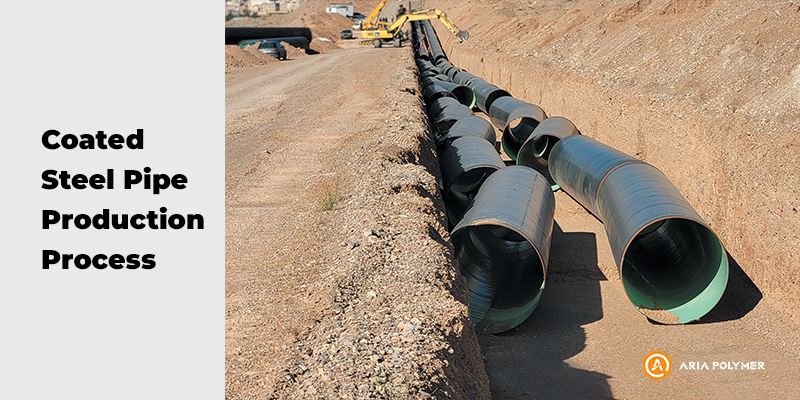
Coated steel pipes are among the most widely used types of pipes in water, oil, gas, and other fluid transmission lines. These pipes are designed to operate under a wide range of environmental conditions, from extremely low temperatures (down to approximately −45 °C) to very high temperatures (such as desert regions with temperatures around 90 °C).
In addition, these pipes are used in special conditions such as subsea applications and, by maintaining their mechanical and protective properties, enable safe and reliable fluid transport. In the following section, the production steps of coated steel pipes are briefly explained in both text and video:
Step 1: Steel Coil
The raw material for steel pipes is steel coil, which is supplied by steel manufacturing companies:

Step 2: Welding
The steel coil is formed into a pipe shape, and its edges are welded together:

Step 3: Surface Preparation
Before applying the coating (coating will be explained in the next step), the pipe surface must be properly prepared. For this purpose, the surface is blast-treated to increase surface roughness, maximize the mechanical adhesion of the coating, and provide a suitable substrate for coating application.
Step 4: Coating
In this step, a coating layer is applied to the surface of steel pipes (because of this coating, these pipes are known as coated steel pipes). This coating forms a protective layer that increases the steel’s resistance to corrosion and ultimately enhances the pipe’s service life and durability.
The coating of steel pipes consists of three layers:
Epoxy or FBE layer (the base layer that adheres directly to the steel surface)
Adhesive layer (the intermediate layer used to bond the coatings)
Polyethylene layer (the outer protective layer)
In the video below, the coating application process on a steel pipe is shown. On the left side of the video, the FBE (fusion-bonded epoxy) layer is sprayed onto the pipe surface. After that, the white layer represents the adhesive layer, and the black layer forms the polyethylene coating:
Step 5: Cooling
After the coating is applied, the pipe is cooled using water or air:

Step 6: Cutback
At this stage, part of the coating at both ends of the pipe (usually between 5 and 30 centimeters) is removed to prepare the pipe for welding and jointing during installation.
Step 7: Peel and QC Tests
The peel test is one of the standard methods used to evaluate the resistance of pipe coatings to applied stress. A standard coating must pass this test within acceptable limits. Along with the peel test, other quality control tests are also performed. It should be noted that depending on the industry and the intended application of the pipe, these tests may vary:

If the pipe passes all tests successfully, it will be ready for installation and operation at the project site.
Steel Pipe Coatin Adhesive (SPC)
As mentioned earlier, the coating of steel pipes consists of three layers: epoxy, an interlayer (tie layer) adhesive, and polyethylene. Aria Polymer is a manufacturer of tie layer adhesives as well as steel pipe coating compound. To receive the technical datasheet, request pricing, or purchase the product, you may contact Aria Polymer through “Contact Us” page.
Stay informed about the latest Aria Polymer’s products by following our LinkedIn page.