



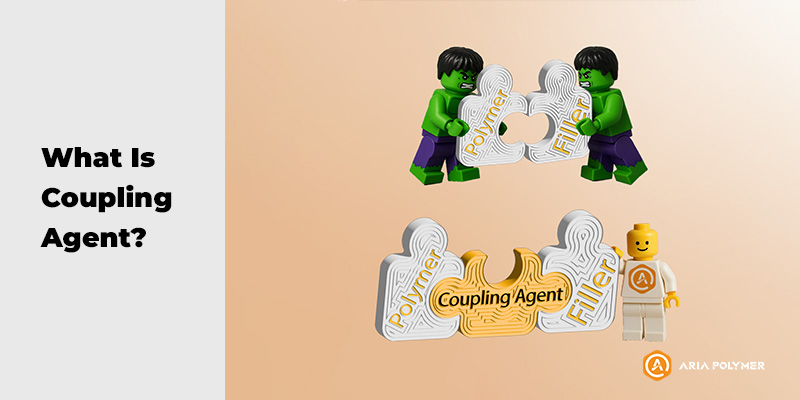
A coupling agent is a chemical additive that bonds two materials that would otherwise refuse to stick together, typically an inorganic material (glass, metal, minerals, fillers) and an organic polymer (resins, rubbers, plastics). Often described as a “molecular bridge,” a coupling agent improves adhesion, strengthens composites, and helps materials survive heat, moisture and mechanical stress. If you work with filled plastics, glass fibre composites, tyres, coatings or adhesives, understanding coupling agents can be the difference between a product that lasts and one that delaminates.
This guide explains what coupling agents are, how they work at the molecular level, the main types (including silane and titanate coupling agents), where they are used, and how to choose the right one.
What Is a Coupling Agent?
A coupling agent is a compound that creates a chemical link between two dissimilar materials, usually one inorganic and one organic. Its molecule contains two different types of reactive groups: one that is attracted to the inorganic surface and another that is compatible with, or chemically reactive toward, the organic polymer.
Because of this dual design, a coupling agent does more than make surfaces “stickier.” It builds a durable interface that transfers stress between the filler or reinforcement and the polymer matrix. The result is a composite with better physical, electrical, thermal and even optical performance than the same formulation without a coupling agent.
Why Inorganic & Organic Materials Do Not Bond on Their Own?
The core problem is a polarity mismatch.
- Inorganic materials such as glass, talc, fibreglass, silica and metals are highly polar and have high surface energy. Their surfaces commonly carry hydroxyl groups (-OH).
- Organic polymers such as epoxy, polyurethane, acrylics, polypropylene (PP) and polyethylene (PE) are weakly polar or non-polar, with flexible molecular chains.
Without help, the polymer simply sits next to the filler instead of bonding to it. In practice this shows up as coatings peeling from glass after boiling, adhesion loss on copper or silver after heat ageing, poor filler dispersion, and composites that fail early under load. A coupling agent solves the incompatibility at its source: the interface.

How Does a Coupling Agent Work?
A good example is the maleic anhydride (MA) coupling agent used in polyolefin composites. It is a polyolefin chain, such as polypropylene (MAPP) or polyethylene (MAPE), carrying grafted maleic anhydride groups. The chain is compatible with the polymer matrix, and the anhydride groups react with the filler or fibre surface. The mechanism has three parts.
1. Grafting: building the dual-function molecule
Maleic anhydride is attached to the polyolefin backbone, usually by free-radical grafting during reactive extrusion. The result is a polymer with a non-polar chain and several polar, reactive anhydride groups along it.
2. Entanglement: integrating with the polymer matrix
In the melt, the polyolefin backbone mixes with the PP or PE matrix and becomes entangled with its chains. Because both are the same type of polymer, the coupling agent stays compatible with the matrix and can crystallise together with it. This anchors the coupling agent firmly on the organic side.
3. Reaction: bonding to the filler or fibre surface
Under melt-processing heat, the anhydride groups react with functional groups on the reinforcement:
- Natural fibres and wood flour: the anhydride reacts with hydroxyl groups (-OH) on cellulose to form ester bonds.
- Glass fibre: the fibre usually carries an aminosilane sizing, and the anhydride reacts with its amine groups to form amide or imide linkages.
- Mineral fillers: the polar anhydride groups, and the acid groups formed when the ring opens in moisture, interact with surface hydroxyls through hydrogen bonding and other polar interactions.
The coupling agent now links fibre and matrix, so stress passes across the interface instead of stopping at it. This is why MAH coupling agents raise the impact and mechanical strength of reinforced polyolefins.
How it differs from a silane coupling agent
- No hydrolysis step. MA grades react in the melt through heat and shear, not through water. Moisture can open the anhydride ring and lower its reactivity, so store the material dry.
- Many anchor points. One chain carries several anhydride groups, and its long backbone entangles with the matrix, instead of acting as a single small-molecule bridge.
- Best fit. MA-grafted polyolefins suit PP and PE compounds with glass, natural or mineral reinforcement. Silanes remain a common choice for glass-filled thermosets and metal-oxide surfaces.
Choosing the grafting level
Grades differ in anhydride content and molecular weight. More anhydride gives more reactive sites on the fibre side, while a higher molecular weight gives stronger entanglement with the matrix. The best grade balances the two for your filler and process.

Key Benefits of Using a Coupling Agent
- Stronger adhesion between fillers, fibres or substrates and the polymer matrix
- Higher mechanical performance, including better impact strength in fibre-reinforced compounds
- Improved durability against moisture, heat ageing and boiling water
- Better filler dispersion and more uniform processing
- Improved electrical, thermal and optical properties of composite materials
- Longer service life and, in rubber, improved wear and ageing resistance
- Potential cost savings, since in some rubber formulations a coupling agent allows a reduction in the amount of natural rubber required
Applications of Coupling Agents
Filled polymer systems
Coupling agents improve compatibility between mineral fillers and both thermoset and thermoplastic polymers, giving more uniform, stronger filled materials.
Glass fibre and carbon fibre composites
Silane coupling agents are used to enhance glass fibre reinforced epoxy and phenolic resins. In thermoplastics, polymer-based coupling agents are used for glass fibre, carbon fibre and mixed-fibre reinforced compounds. A well-known example is polypropylene glass fibre (PPGF) in automotive parts, where strong adhesion supports high material strength together with good impact performance and low emissions.
Rubber and tyres
In the rubber industry, coupling agents improve the wear resistance and ageing resistance of tyres, sheets, hoses and footwear. Vinyl silanes are used as filler treatments and for crosslinking polyolefins.
Coatings, inks and adhesives
Coupling agents help coatings bond to glass and metal, resist peeling after boiling or thermal ageing, and perform on difficult substrates such as copper and silver.
Thermoplastic composite tapes
Coupling agents support the production of PE and PP fibre-reinforced tapes, where processability and tape mechanical properties matter.
Wood plastic composites (WPC)
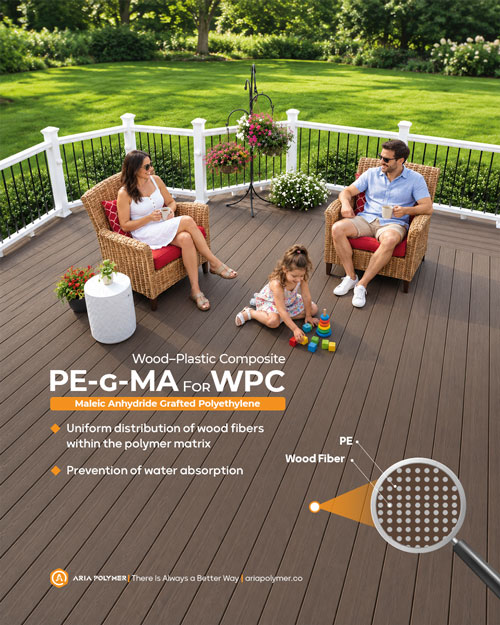
In PP- and PE-based wood plastic composites, coupling agents bond the natural fibre to the polymer. The manufacturer of Yparex grades reports that independent studies showed strong mechanical performance and roughly 5% lower energy consumption versus a reference material, and notes that granulate grades can skip a costly powdering step.
Biomaterials
Silane coupling agents are also used in biomaterial applications, where interface control between inorganic and organic phases is essential.
Conclusion
A coupling agent solves one of the oldest problems in materials science: getting inorganic and organic materials to work together. By anchoring to the inorganic surface at one end and integrating with the polymer at the other, it turns a weak interface into a strong, durable one. Whether you are formulating glass fibre reinforced compounds, designing rubber for tyres, or developing coatings that must survive heat and moisture, choosing the right coupling agent for your substrate, resin and process is one of the most effective ways to improve product quality.
ARIA POLYMER
Aria Polymer is a manufacturer of various polymer additives, including additive masterbatches, coupling agents, and compatibilizers. For orders, price inquiries, technical consultation, and more, please get in touch with us through the contact options available on our Contact Us page.
Stay informed about the latest Aria Polymer’s products by following our LinkedIn page.