



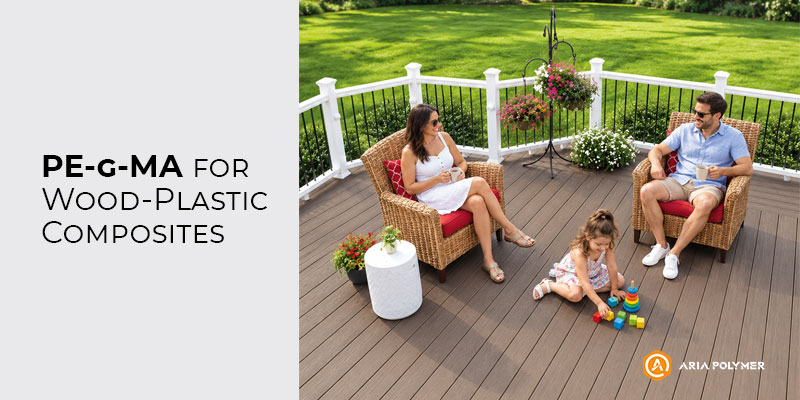
Wood-plastic composite (WPC) has grown from a niche decking material into a mainstream building product. A 2025 review expects the global WPC market to reach about USD 15.4 billion by 2030, growing at roughly 11.6% a year.
That growth rests on a detail most buyers never see: how well the wood fibers bond to the plastic around them. This guide explains what WPC is, how it is made, and how PE-g-MA (maleic anhydride grafted polyethylene) from Aria Polymer turns a simple wood-plastic blend into a strong, water-resistant composite.
What Is Wood-Plastic Composite (WPC)?
Wood-plastic composite is a material made from wood fibers or wood flour, a thermoplastic polymer and a small package of additives. It gives the natural look of wood together with the moisture resistance and low upkeep of plastic.
Polyethylene is the leading matrix. Polyethylene grades account for about 65% of WPC production, PVC for about 15% and polypropylene for about 10%.
Compared with solid timber, WPC resists rot, decay and termites. It does not splinter and needs no painting, staining or sealing. Many producers also make it from sawmill waste and recycled plastics, which supports circular-economy goals.
What Is WPC Made Of?
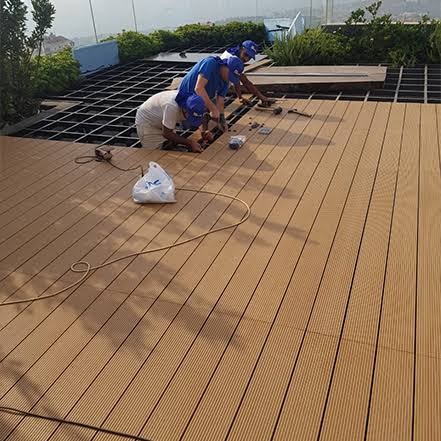
A typical WPC formulation contains 50–70% wood and 30–50% polymer, plus a few percent of additive. One European decking producer, for example, uses about two-thirds wood flour and one-third HDPE.
| Component | Common choices | Role in the composite |
|---|---|---|
| Wood filler | Wood flour or fibers from pine, fir, spruce or hardwood | Stiffness, natural appearance, lower material cost |
| Polymer matrix | HDPE, PP, PVC, virgin or recycled | Binds the fibers, blocks moisture, allows melt processing |
| Coupling agent | PE-g-MA for polyethylene-based WPC | Bonds wood to polymer and helps fibers disperse |
| Lubricants | PE waxes, stearates, esters | Smoother flow and better surface finish |
| Stabilizers and pigments | UV stabilizers, antioxidants, colorants | Color retention and outdoor durability |
Ingredient quality sets product quality. Wood species, particle size and wood content all change how the compound flows and how the finished profile performs.
How Is WPC Manufactured?
WPC production has two stages: compounding, which blends wood and additives into molten polymer, and forming, which shapes that compound into a product. On a typical profile line the steps are:
- Raw material preparation. Wood is dried to remove excess moisture and every component is weighed to the formula. Moisture control is essential for a good wood-polymer bond.
- Compounding. Wood, polymer and additives are mixed into a homogeneous melt. The coupling agent is added here. Poor mixing leaves weak spots and uneven surfaces.
- Extrusion or injection molding. The melt is pushed through a die to form continuous profiles such as deck boards. Injection molding is used for more complex parts.
- Cooling and calibration. Controlled cooling fixes the dimensions and prevents warping and surface defects.
- Surface finishing. Boards are embossed, brushed or sanded. Some lines co-extrude a protective cap layer against UV, stains and scratches.
- Quality control. Producers check density, dimensions, water absorption, weather resistance and surface quality.
Temperature is the main processing limit. Wood starts to degrade thermally at about 200–220 °C, so WPC is processed at roughly 200 °C or below.
Wood and Polyethylene Do Not Bond Naturally!
Wood and polyethylene are chemical opposites. Wood is hydrophilic and absorbs moisture, while polyethylene is hydrophobic and non-polar.
Without help, molten polyethylene wets wood fibers poorly. The result is a WPC with three typical problems:
- Fiber agglomeration. Wood particles clump together instead of spreading evenly through the matrix.
- A weak interface. Stress cannot pass from the polymer to the stiffer wood, so the board is weaker than its recipe suggests.
- Paths for water. Gaps around poorly bonded fibers let moisture reach the wood, which leads to swelling.
Research reviews identify interfacial adhesion and filler morphology as the main factors controlling WPC properties. In hydrophobic matrices such as PE, strength falls as wood content rises unless the interface is improved. This is the problem a coupling agent solves.
What Is PE-g-MA and How Does It Work in WPC?
PE-g-MA is polyethylene with maleic anhydride groups chemically grafted onto its chain. It is also called maleic anhydride grafted polyethylene, MAPE, PE-g-MAH or maleated polyethylene.
The molecule has two sides, and each one suits a different phase of the composite:
- The maleic anhydride groups are polar. They react with the hydroxyl groups on the wood surface, forming ester and hydrogen bonds that anchor the molecule to the fiber.
- The polyethylene backbone is non-polar. It entangles and co-crystallizes with the polyethylene matrix.
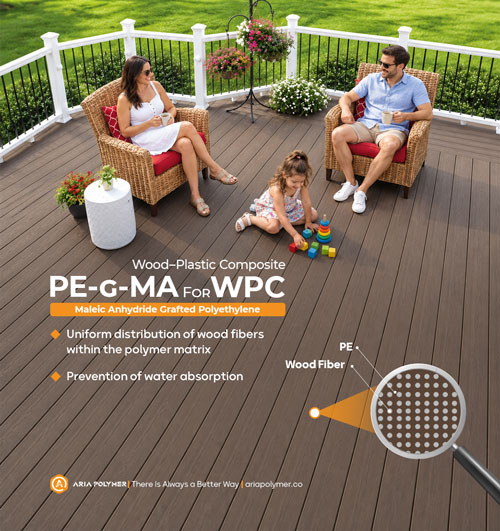
PE-g-MA therefore acts as a molecular bridge between wood and plastic. The polymer wets the fibers, the fibers separate and spread evenly, and the finished profile behaves as one material instead of two.
The benefit goes beyond a single chemical reaction. A 2021 study on composites with 80% wood fiber found that performance gains were larger than esterification alone could explain.
Benefits of PE-g-MA in Wood-Plastic Composites
PE-g-MA improves the three properties WPC buyers care about most: appearance, strength and moisture resistance.
- Uniform distribution of wood fibers in the polymer matrix. Better wetting breaks up agglomerates. Profiles come out with a more consistent surface, color and density.
- Lower water absorption. A tight interface leaves fewer gaps for moisture, so boards swell less. Composites compatibilized with MAPE absorbed less water than untreated ones.
- Higher mechanical strength. In the same study, tensile strength rose by 224% and flexural strength by 189% at 80% wood content. Reviews report strength gains of 1.5 to 2 times for maleated coupling agents in some formulations.
- Better long-term performance. Coupled composites show improved creep resistance and dimensional stability under sustained load.
- More freedom in formulation. A stronger interface helps producers raise wood content or use recycled polyethylene while keeping properties on target.
Actual gains depend on wood type, filler level, polymer grade and processing conditions, so each formulation should be confirmed by testing.
Where Is WPC Used?
WPC is used wherever the look of wood is wanted without its maintenance, mainly in construction and outdoor living. Common applications are:
- Outdoor decking and flooring for terraces, balconies and pool surrounds
- Wall cladding and siding
- Fencing, railing and screening
- Outdoor furniture such as benches and picnic tables
- Interior wall panels, ceilings and skirting boards, including in kitchens and bathrooms
- Window frames and noise protection walls
- Automotive interior parts, where natural fibers help reduce weight
Decking and other load-bearing profiles gain the most from a coupling agent. They carry weight, stay outdoors for years and face rain, humidity and temperature swings every day.
Aria Polymer PE-g-MA for WPC
Aria Polymer produces PE-g-MA as a coupling agent for polyethylene-based wood-plastic composites. For product grade, technical datasheet, sample, pricing, and technical consultation, please contact us.
Stay informed about the latest Aria Polymer’s products by following our LinkedIn page.