

Investment in anti-pollution, environmentally friendly, and biodegradable projects has increased in most countries due to new regulations and global environmental considerations.
Among all packaging methods in the industry, reusable packaging and biodegradable packaging have gained more popularity. Biodegradable containers encompass a wide range of starch-containing materials, including wood flour, bamboo flour, wheat, corn, polylactic acid (PLA), polyhydroxyalkanoates (PHA), rice, and other bio-based raw materials.
Plant-Based Disposable Containers
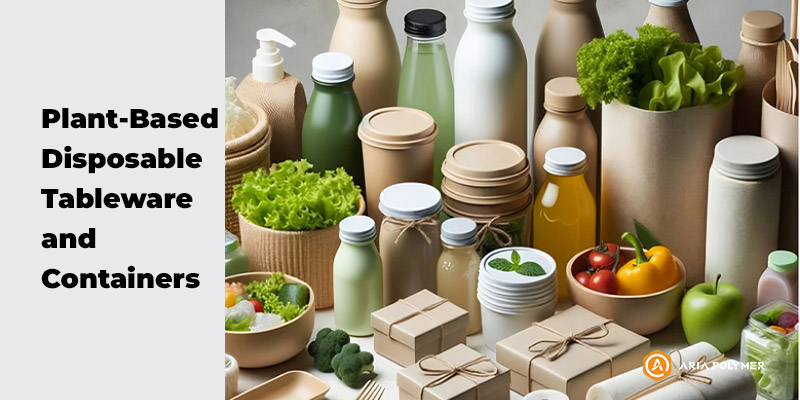
Plant-based disposable tableware and Containers are a suitable and eco-friendly alternative to plastic containers, which are sourced from petrochemical raw materials or recycled materials.
This disposable tableware is made of natural and biodegradable materials, and they help reduce environmental pollution.
Raw Materials for Plant-Based Disposable tableware
Various raw materials are used for the production of plant-based disposable tableware:
Poly-lactic Acid (PLA)
Poly-lactic Acid (PLA) is a semi-crystalline, thermoplastic, and aliphatic biodegradable polymer that is considered a sustainable alternative to traditional petroleum-based plastics.
PLA is created through the chemical process of the lactic acid monomer or the fermentation of carbohydrates from renewable sources like starch and sugar. This polymer is recognized as a unique and biodegradable substitute for plastics.
Despite having good features and properties, PLA suffers from low flexibility, low impact strength, and low thermal stability, especially for processing it in its molten state, which limits its applications compared to other polymers.
Modifying Poly-lactic Acid (PLA)
Given these limitations, research has been conducted to modify the properties of PLA to match specific needs. Depending on the application, each of these properties may be modified to improve the overall characteristics:
- To enhance the thermal stability and tensile strength of PLA, reactive-processing with coupling agents is used.
- To improve the brittleness and impact resistance of PLA-based products, methods such as blending it with softer polymers, plasticization, and copolymerization are employed.
These solutions lead to a reduction in modulus, and an improvement in impact resistance and processability.
PLA Applications and Decomposition
Processed Poly-lactic Acid (PLA) is used to produce cups, spoons and forks (cutlery), and food packaging containers and tableware.
It ultimately decomposes through hydrolytic cleavage and an erosion mechanism. The hydrolytic degradation of polymers involves the cleavage (or cutting) of the main chain molecules, which leads to a reduction in molecular weight and loss of mass. Generally, the decomposition of PLA occurs in approximately 6 to 24 months, depending on the environmental conditions.
Polyhydroxyalkanoates (PHA)
Polyhydroxyalkanoates (PHAs) belong to the family of optically active polyesters with the monomer unit –3-hydroxyalkanoic acid, and they are produced through the microbial fermentation of sugars or lipids.
PHAs have received significant attention due to their good biocompatibility, biodegradability, and thermal and mechanical properties.
These biodegradable thermoplastics feature an ester bond between the carbonyl group of one molecule and the hydroxyl group of another molecule. Their thermal and mechanical properties are similar to those of polyethylene and polypropylene.
PHA Properties and Applications
Polyhydroxyalkanoates (PHAs) are highly resistant to UV radiation and are impermeable to water vapor and aroma, which makes them a suitable material for food packaging.
PHAs are:
- Impermeable to flavor and odor
- Resistant to grease and oil
- Printable
- Possess good tensile strength
- Have temperature stability
- Are heat-sealable
- They are also easy to color, which increases their use in the food industry.
PHA can be used to prepare bottles, films, containers, tableware and coatings for food packaging.
However, the properties of these thermoplastics can be improved by blending them with other polymers such as polyethylene, polypropylene, poly-lactic acid, cellulose, and starch.
Decomposition
Polyhydroxyalkanoates are suitable for producing more resistant tableware and for specific applications. These tablewares easily decompose in nature within 3 to 6 months.
Blends of Polypropylene and Natural Polymers
The natural raw materials used for producing these containers are often from renewable, starch-containing sources such as corn, wheat, and rice. These materials contain polar segments and have high degradability.
These natural polymers such as starch, are combined with petrochemical raw materials like polypropylene (PP) and, through chemical and thermal processing, are transformed into a resistant material that is used as the base for manufacturing tableware.
Incompatibility in nature between the natural filler and the thermoplastic material causes problems in the processing and material properties of the composite. To overcome these issues, various physical and chemical methods are used to modify the surface of the materials.
Surface Modification of Non-Polar Polymers
Surface modification of non-polar polymers is essential for the processing and final application of products in the plant-based tableware manufacturing industry. For this purpose, coupling agents or functional groups are utilized.
Role of Maleic Anhydride-Grafted Polypropylene (PP-g-MA)
Maleic Anhydride-Grafted Polypropylene (PP-g-MA) is currently the key material for creating uniform dispersion of the polar phase within the polymer, acting as a compatibilizer and adhesion promoter between the two phases.
This substance can significantly improve the compatibility of different phases in composite materials and the dispersion of fillers in the polymer. The anhydride group present in maleic anhydride can react with the hydroxyl or amine groups present in natural fillers (such as starch) to form covalent bonds.
The combination of corn starch with polypropylene and maleic anhydride increases the tensile strength and decreases the tensile modulus; while no significant change occurs in the elongation.
Manufacturing Process of Plant-Based Disposable Tableware
The manufacturing process for plant-based disposable tableware and containers involves a series of stages where the raw materials (such as corn starch, polylactic acid (PLA), and related additives like compatibilizers) are transformed into usable containers. This process relies on the selection of suitable primary material and the execution of mechanical, chemical, and thermal steps.
Raw Material Processing
This stage involves preparing the primary materials before they are formed into tableware and containers. First, the raw materials are mixed with appropriate additives. Then, the mixed materials are subjected to heat to transform them into a resistant dough or melt. This dough/melt is used as the base material for manufacturing the tableware.
Key Additives
The additives used in this stage are crucial for achieving the desired physical and functional properties:
- Plasticizers: Used to increase flexibility and make the material less brittle, which is essential for forming the final tableware shape.
- Cross-linking Agents: Used to improve strength and stability. These agents create chemical bonds between the polymer chains, significantly enhancing the material’s mechanical properties, such as stiffness and heat resistance.
- Pigments: Used for coloring the tableware.
Extrusion
The prepared mixture is fed into an extrusion machine. In this stage, the materials are melted by heat and formed into thin sheets or a doughy material.
Molding
The sheets or dough are fed into specialized molds. The materials inside the molds are subjected to appropriate pressure and temperature to take on their final shape.
Cooling and Drying
The shaped tableware is removed from the molds and transferred to the cooling lines. This stage increases the strength and reduces the moisture content of the tableware.
Trimming and Finishing
The excess edges (flashing) of the tableware are cut off (trimmed), and their surfaces are processed (finished) to ensure the visual quality of the final product.
The production of plant-based disposable tableware is an advanced industrial process that involves the use of natural and renewable materials, modern molding technologies, and a commitment to environmental preservation. Despite the existing challenges, this industry plays a crucial role in sustainable development, reducing the harmful effects of conventional plastic, and manufacturing eco-friendly products.