



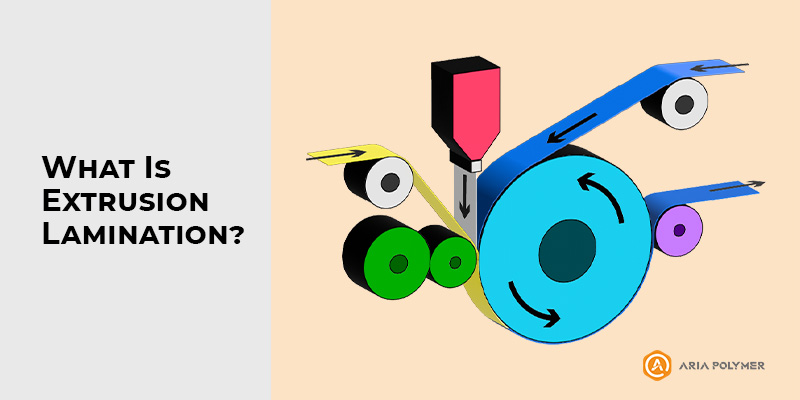
The flexible packaging industry has been moving steadily toward higher performance, lower environmental impact, and greater production efficiency. Among the various material-conversion technologies available, extrusion lamination stands out as one of the most reliable and cost-effective ways to produce flexible multilayer structures.
Whether you manufacture packaging, or manage a brand that needs better barrier properties, stronger seals, or a more stable production process, understanding this technology is a good place to start. This guide walks through what extrusion lamination is, how it works, common materials, and where it’s used across industry.
What Is Extrusion Lamination?
Extrusion lamination is a process in which a molten thermoplastic resin is extruded through a flat die and used, in place of conventional solvent-based or water-based adhesives, as the bonding layer between two or more substrates. Machines that perform this process are often called “extrusion coating and lamination machines,” because they can typically handle both coating (applying a single layer) and lamination (bonding two or more layers).
The substrates involved can vary widely, plastic film, woven fabric, lightweight paper, or aluminum foil. The extruded resin, typically polyethylene, is applied between these layers and immediately pressed together by a chill roll and a pressure nip to form a strong, uniform bond without damaging the substrate. On some lines, a second layer is added at this stage to increase strength or add functionality.
The result is a multilayer structure that combines the best properties of each material: the mechanical strength of paper or fabric alongside the barrier properties of the polymer. The finished product resists moisture, oxygen, oil, light, taste transfer, and heat, qualities that make it well suited to food packaging, medical packaging, and industrial applications.

Common Thermoplastic Resins Used in Extrusion Lamination
One of the following resins is typically extruded as the bonding layer between substrates:
- LDPE (Low-Density Polyethylene)
- LLDPE (Linear Low-Density Polyethylene)
- PP (Polypropylene)
- EVA (Ethylene Vinyl Acetate)
- EAA or EMA, for applications that need extra adhesion
The choice of resin directly affects the finished product’s performance and can improve:
- Moisture resistance
- Resistance to gas penetration
- Heat-seal quality
- Durability and tear resistance
Extrusion Lamination vs. Adhesive Lamination
In traditional adhesive lamination, layers are bonded using solvent-based adhesives. In extrusion lamination, the molten polymer itself acts as the adhesive, eliminating the need for traditional adhesives entirely.
That seemingly simple difference brings several important advantages: lower VOC (volatile organic compound) emissions, a smaller environmental footprint, and better cost-efficiency compared with traditional adhesive lamination.
The Extrusion Lamination Process, Step by Step
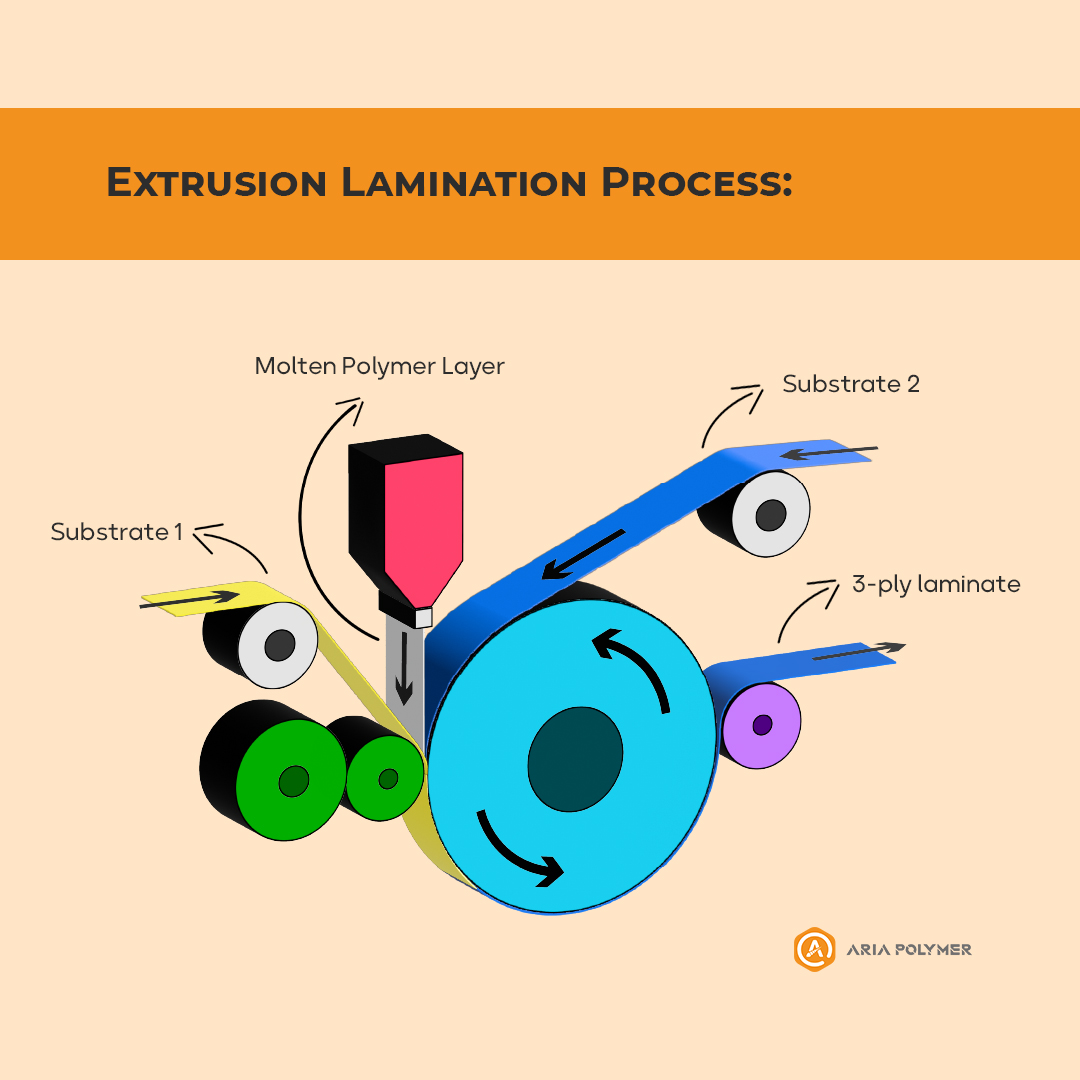
A standard extrusion lamination line consists of several coordinated systems that together ensure a uniform bond and high production speed. Here’s how the process breaks down into six main steps.
1. Unwinding the Substrate Rolls
The process begins with two or more primary and secondary substrate rolls, such as PET film, BOPP, aluminum foil, or paper, unwinding under precisely controlled tension. Stable tension is critical at this stage, since any fluctuation can cause wrinkling or misalignment.
2. Surface Treatment (Corona or Flame)
Before reaching the extrusion station, the substrate surface is typically treated with corona or flame treatment. This raises the material’s surface energy, which helps the molten polymer bond more effectively to it later in the process.
3. Polymer Melting and Extrusion
Plastic pellets are fed into a single-screw extruder. Inside the barrel, the screw rotates, the resin melts across controlled temperature zones, and the molten polymer is directed toward a flat T-die. The result is a uniform curtain of molten polymer that spreads evenly across the full web width.
4. The Lamination Nip
The molten polymer is cast directly onto the primary substrate. The secondary substrate is immediately added, and the combined layers are pressed together between a rubber pressure roll and a chrome chill roll. This pressure ensures full contact between the layers and a proper bond.
5. Cooling and Solidification
The chill roll immediately cools the newly formed laminate. This rapid cooling freezes the polymer layer in place and stabilizes the final structure.
6. Edge Trimming and Rewinding
In the final step, excess edges are trimmed and the finished laminate, ready for downstream processes like printing or pouch-making, is rewound onto a roll.
Key Advantages of Extrusion Lamination
Why do so many flexible packaging manufacturers choose extrusion lamination? The technology offers a combination of operational and economic advantages:
- Strong, Uniform Bonding: Because the adhesive layer is molten polymer, bond strength stays consistent across the full web width, and with proper process control, the risk of delamination is minimized.
- Solvent-Free Process: Unlike dry lamination, there’s no solvent and no curing oven involved, which means lower VOC emissions, a smaller environmental footprint, and shorter production cycles.
- High Production Speed: Modern extrusion lamination lines can run at high line speeds without sacrificing coating thickness or bond quality.
- Cost-Effectiveness: Since no separate adhesive material is needed, the same resin serves as both the bonding layer and a functional layer — for example, a moisture barrier or heat-seal layer.
- Excellent Barrier and Seal Performance: The process is widely used specifically to improve moisture resistance, oxygen barrier, heat sealing, and mechanical strength.
- Application Versatility: A wide range of substrates — film, foil, and paper — can be laminated using this method.
Applications of Extrusion Lamination Across Industries
Extrusion lamination’s range of applications spans several industries:
- Food Packaging: Snack bags, frozen food packaging, coffee pouches, and dairy and liquid packaging
- Pharmaceutical and Medical Packaging: Sterile bags, medical packaging film, and infusion bags
- Industrial Packaging: Heavy-duty bags, protective film, agricultural film, and building insulation
- Paper Lamination: Laminated kraft paper and liquid carton packaging
- Consumer Products: Stand-up pouches and liquid cartons
Final Words
Extrusion lamination has become one of the core technologies in flexible packaging: a solvent-free process that runs at high speed while improving barrier properties and seal strength at the same time. For manufacturers looking for higher quality, lower cost, and greater efficiency, investing in a well-engineered extrusion lamination line can deliver a meaningful competitive advantage.