




Nylon is strong, stiff and easy to mould, yet a PA6 or PA66 part that passes a tensile test can still snap when dropped, clipped into place or used on a frosty morning. The problem is brittleness, not weakness. A polyamide impact modifier is the additive compounders use to fix it.
This guide covers what a nylon impact modifier is, what it does, where it is used and how to choose one.
Why PA6 and PA66 Need Toughening
Strength is the load a part carries, toughness is the energy it absorbs before breaking. Dry-as-moulded PA6 and PA66 are strong, but they are notch sensitive. A sharp internal corner, a weld line, a rib root or a screw boss concentrates stress, and a small knock at that spot can start a crack that runs straight through the part.
Three conditions that make it worse
- Low temperature. As the temperature falls, polyamide moves towards brittle behaviour. A grade that bends at room temperature may shatter at −30 °C.
- Fast loading. Drops, hammer blows and snap-fit assembly give the polymer chains no time to relax.
- Fillers, glass fibre and recycling. Reinforcement adds stiffness but also adds fibre ends where cracks can start. Repeated processing of recycled nylon lowers molecular weight and makes it more brittle.
Moisture also matters: conditioned nylon is tougher but less stiff. A good impact modifier for nylon 6 or PA66 delivers toughness without relying on water uptake in service.
What Is a Polyamide Impact Modifier?
A PA impact modifier is a rubbery polymer that is compounded into the nylon so that it forms a separate, finely dispersed phase of soft particles inside the rigid matrix. The modifier does not change the polyamide itself. It changes how the compound responds when it is struck.
Maleic anhydride grafted elastomers
Most modifiers used in polyamide today are maleic anhydride grafted polyolefin elastomers. A reactive maleic anhydride (MA) group is grafted onto a flexible backbone, usually by reactive extrusion. Common families include:
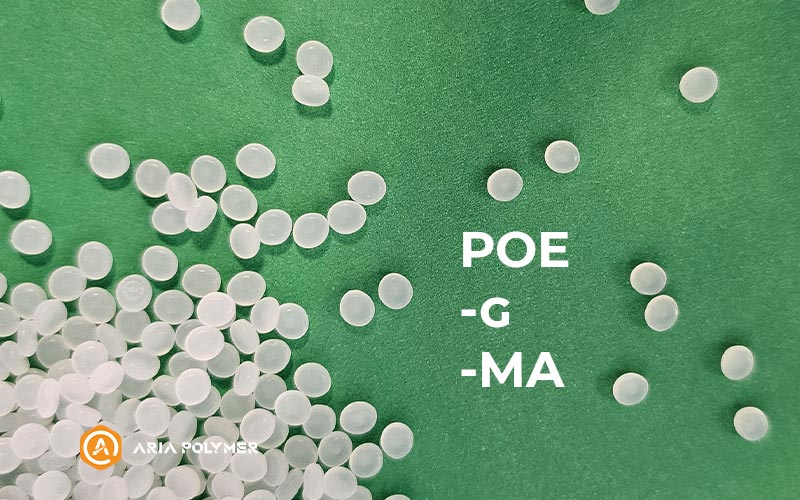
- POE-g-MA: polyolefin elastomer (for example ethylene-octene) grafted with maleic anhydride. It is widely used in PA6 and gives good low-temperature ductility.
- EPDM-g-MA and EPR-g-MA: ethylene-propylene rubbers with a grafted anhydride. They are often chosen for PA66.
- SEBS-g-MA: a styrenic block copolymer with good thermal stability and elastic recovery.
- PE-g-MA: grafted polyethylene. It is used as a compatibiliser or as part of a toughening package, often together with an elastomer.
Reactive compatibilisation: the key mechanism
Polyolefin rubber and nylon do not mix on their own. If you simply blend them, the rubber forms large, poorly bonded droplets that act as defects. The anhydride group solves this. During melt compounding it reacts with the amine end groups of the polyamide chains and forms a graft copolymer right at the interface. That in-situ copolymer does two jobs:
- It lowers interfacial tension, so the rubber breaks up into much smaller particles.
- It anchors those particles to the matrix, so they stay small during moulding and do not pull away under load.
Particle size and dispersion
Toughening depends heavily on morphology. Well-compatibilised systems typically produce rubber particles from a fraction of a micron up to about one micron, and reactive systems are commonly reported in roughly the 0.2–1.0 µm range. When the compound is hit, these particles cavitate and stretch. That triggers shear yielding in the surrounding nylon, which absorbs far more energy than a clean brittle fracture. Particles that are too large (several microns), clustered or weakly bonded do the opposite: they act as flaws, and the compound can end up more brittle than the base resin.
Dispersion is set in the extruder, so two compounds with the same modifier percentage can perform very differently.
What a Nylon Impact Modifier Does
- Higher notched impact strength (Izod or Charpy), at room temperature and especially at sub-zero temperatures.
- A change from brittle to ductile failure: the part bends and yields instead of shattering.
- Better tolerance of notches, sharp corners and thin ribs that cannot easily be redesigned.
- More consistent dry-as-moulded toughness, with less dependence on moisture conditioning.
- Partial recovery of toughness in recycled PA6 and PA66. Badly degraded material may also need chain extension and stabilisation.
Typical loading levels
Polyamides are usually toughened with a modifier content from a few percent up to around a fifth of the compound. In practice, trials often cover about 5–20 wt%, and a common approach is to test three points such as 5%, 10% and 15% to find the best grade and dose. Toughness is often grouped into three bands:
| Toughness class | Typical notched Izod (at test temperature) |
|---|---|
| General-purpose | approx. 100–210 J/m |
| Intermediate | approx. 160–320 J/m |
| Super-tough | no break, typically > 800 J/m |
Super-tough performance in PA6 has been reported at around 15 wt% of a suitable grafted modifier. Temperature matters a great deal: a compound that is super-tough at room temperature may only reach general-purpose toughness at −40 °C. Always state the temperature with the number.
Trade-offs to plan for
Toughening always costs something. As the modifier level rises, expect:
- Lower stiffness and tensile strength. The soft phase carries little load, so flexural modulus falls as the modifier content rises.
- Lower melt flow. Thin walls and long flow paths become harder to fill.
- A slightly lower heat deflection temperature (HDT), especially at high loadings.
- Changes in shrinkage and warpage, because crystallisation behaviour shifts.
The best loading is the lowest one that moves the failure mode from brittle to ductile at your service temperature.
Impact modifiers with glass fibre
Glass-fibre-reinforced polyamide can be impact modified, but the balance is tighter: the modifier gives back some of the stiffness the glass provides. A compound with high glass content and a high modifier level can end up with neither the rigidity of a reinforced grade nor the toughness of a modified one. Design the reinforcement and toughening as one package rather than adding them separately.
Where Polyamide Impact Modifiers Are Used
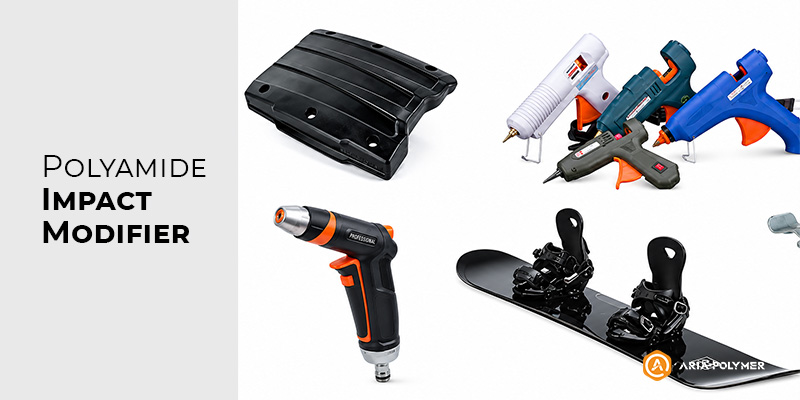
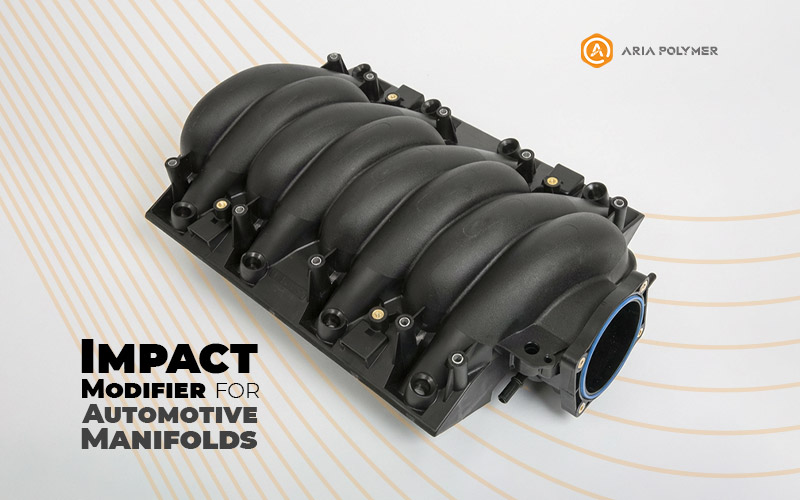
- Automotive: brackets, covers, clips, connectors, interior trim, bumper-related parts and under-the-hood components such as air intake parts and coolant reservoirs that must keep their toughness in winter.
- Cable ties and fasteners: parts that are bent sharply at assembly and must not crack in cold or dry conditions.
- Electrical and electronics: housings, connectors and snap-fit enclosures.
- Consumer goods: power tool housings, home appliance parts and everyday items that get dropped.
- Sports equipment: ski boot shells and protective gear.
- Industrial: pipes, fittings, machinery parts and metal-replacement components.
Aria Polymer's Approach
At Aria Polymer we work with compounders who need a dependable maleic anhydride grafted modifier for polyamide. Our Aria Couple range includes POE-g-MA grades (1946 and 1947 grades) designed for toughening and compatibilising PA. If you are evaluating a nylon impact modifier for a new compound, our technical team is happy to discuss your target properties and suggest a grade to trial.
Stay informed about the latest Aria Polymer’s products by following our LinkedIn page.